

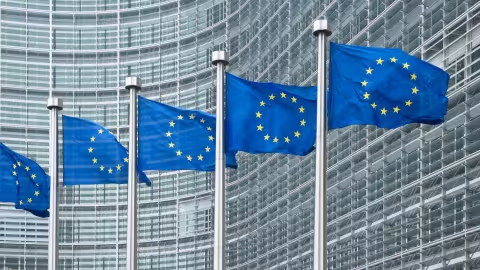
On 14 October, the European Commission presented the EU Water Resilience Investment Accelerator by Green Assist (advisory initiative under InvestEU, funded by the LIFE programme). The accelerator will support 20 innovative pilot projects on natural water retention, clean water and water efficiency. It will bring together investors, solution providers and sectors facing water-related challenges, inspiring similar action across the EU.
Latest articles

At the 26th International Congress on Irrigation and Drainage (ICID 2026), held in Marseille from October 12–17 and bringing together more than 1,000 irrigation and drainage specialists from around the world, Société du Canal de Provence (SCP) unveiled Future Hydro, an ambitious initiative designed to transform existing water distribution networks into intelligent systems capable of anticipating demand, optimizing water transfers, and reducing energy consumption. The ultimate goal is to strengthen regional resilience to climate change.
Le
Par SCP
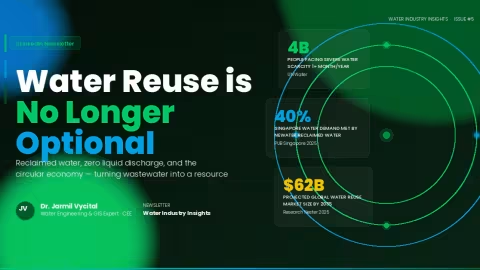
For most of the 20th century, water management followed a simple logic: extract, treat, use, discharge. A linear model built on the assumption that freshwater was abundant, affordable, and reliably available.
Le
Par Dr Jarmil Vycital
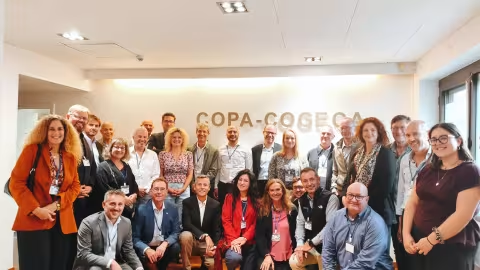
IA Irrigation Days 2026: Bringing Industry and EU Policymakers Together for a Water-Resilient Europe
On September 28–29, 2026, the European Irrigation Association (EIA) brought together irrigation professionals, European policymakers, financial institutions and environmental organisations in Brussels to discuss the industry's future and its contribution to Europe's Water Resilience Strategy.
Le
Par Fleur Martin, Irrigazette
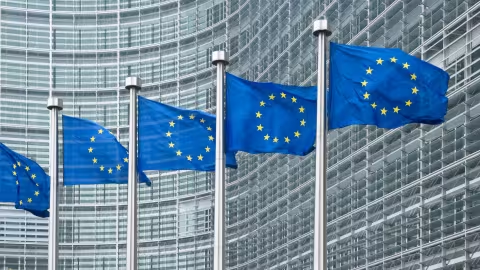
On 16 September, Ursula von der Leyen, President of the European Commission, delivered her State of the Union Speech for 2026, which sets out the priorities of the European Commission for the next year. On water resilience and agriculture, the speech focused mostly on water savings and drought management via adaptation.
Le
Par Justine Marrot, Alienor
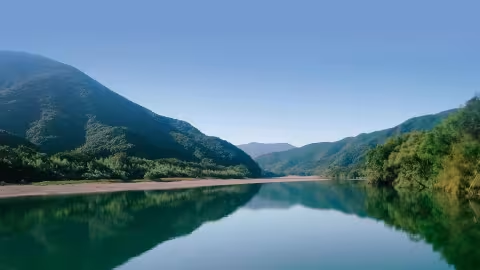
Today, the importance of wastewater treatment cannot be overstated when it comes to sustainable water management. With a growing population and expanding industrial activity, the volume of wastewater being generated is reaching alarming levels.
Proper wastewater treatment is essential to remove pollutants and contaminants, protect water sources, and encourage the reuse of treated water.
Le
Par Eatay Pomeranz, Technology Manager, Amiad