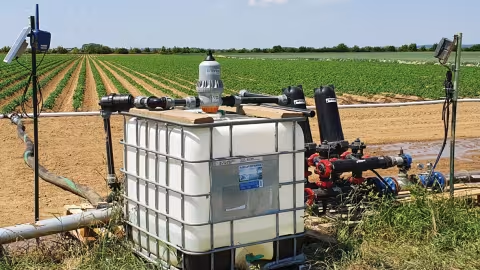
For growers, fertilizer has always been one of the most important and more costly inputs in the field. Today, it is also one of the most unpredictable.
Prices have become more volatile; supply chains remain exposed to geopolitical and energy shocks, and margins are under pressure across many crops and regions. Farmers are being asked to produce more with greater efficiency, while managing input costs that can change quickly and significantly from one season to the next.
In this environment, fertigation management can no longer be treated as a routine operational task. Every kilogram applied needs to maximize its efficiency and reach the crop at the right time and the right dose support yield without unnecessary waste.
Historically, irrigation scheduling and fertilizer management have often been handled through separate systems. One determines when water is applied. The other governs nutrient injections. In practice, however, these decisions are deeply connected. Irrigation timing influences nutrient availability, while nutritional strategy often shapes irrigation decisions.
Drip irrigation was the key driver behind the transition to precision irrigation. It also transformed fertigation practices from quantitative application to proportional fertigation, or 'spoon-feeding,' allowing growers to supply water and nutrients precisely according to crop demand
That is why fertigation is becoming increasingly important. By delivering nutrients through irrigation systems, growers can apply fertilizers in smaller, more targeted doses and align nutrition more closely with actual crop demand.
The agronomic case is already well established. A global meta-analysis of fertigation trials across multiple crops found that, compared with conventional irrigation and fertilization, fertigation increased average yields by 20%, nutrient-use efficiency by 26%, and water productivity by 51% (WUE – Water Use Efficiency), largely by helping crops access water and nutrients more consistently throughout the growing cycle.
But the economic case is becoming just as compelling. When fertilizer prices are unstable, efficiency is not only an environmental or agronomic priority. It is a direct lever for cost reduction, helping growers lower unnecessary input spend while protecting yield potential.
Those gains have helped make fertigation standard practice across much of horticulture, protected agriculture, orchards and an increasing number of field crop operations.
Getting fertilizer into an irrigation system is no longer the challenge. Growers solved that problem years ago. The question increasingly facing farms is how to manage nutrition effectively when irrigation schedules, crop demands, and operating conditions are becoming more dynamic.
Precision matters when every input counts
Part of the reason is that irrigation itself looks very different today than it did a decade ago. Instead, irrigation is increasingly spread across much of the day to maintain more stable root-zone conditions and improve resource efficiency. That shift has brought clear agronomic benefits, but it has also changed the management challenge. Fertigation strategies developed for shorter irrigation cycles do not always translate neatly to systems operating for much longer periods.
Any farmer who has managed a crop through a difficult season knows that nutrient demand rarely follows a tidy schedule. Uptake changes throughout the season and is influenced by soil moisture, root-zone conditions, temperature, crop stage and irrigation timing. What works early in the season may not be appropriate several weeks later. Even within the same field, conditions can shift as weather patterns change, or crop demand accelerates.
This is where precision matters. Instead of applying fertilizer in concentrated doses and hoping the crop can use it efficiently, growers are increasingly moving toward proportional dosing strategies that spread nutrients across irrigation cycles and adjust delivery according to changing crop needs.
The logic is simple: when fertilizer is expensive and availability is uncertain, waste becomes harder to justify. Better timing, better distribution, and better control can reduce over-application, improve nutrient uptake, and help growers protect both productivity and profitability.
This matters because the pressures facing growers are not temporary. Fertilizer markets will continue to be influenced by energy costs, trade disruptions, regulation and geopolitical uncertainty. Water scarcity will continue to shape irrigation decisions. Labor constraints will continue to push farms toward more efficient, reliable, and automated ways of working.
Water and nutrients need to be managed as one system
That connection isn't just the rationale for fertigation; it also determines how fertigation needs to be managed in practice.
Crops do not experience water and nutrition as separate processes. Nutrient availability depends on water movement, root-zone conditions, and irrigation timing. Likewise, irrigation decisions influence how effectively fertilizer is taken up by the plant. That is why the future of fertigation is not simply about adding more technology to the farm. It is about connecting decisions that already belong together and giving growers a clearer, more practical way to manage them.
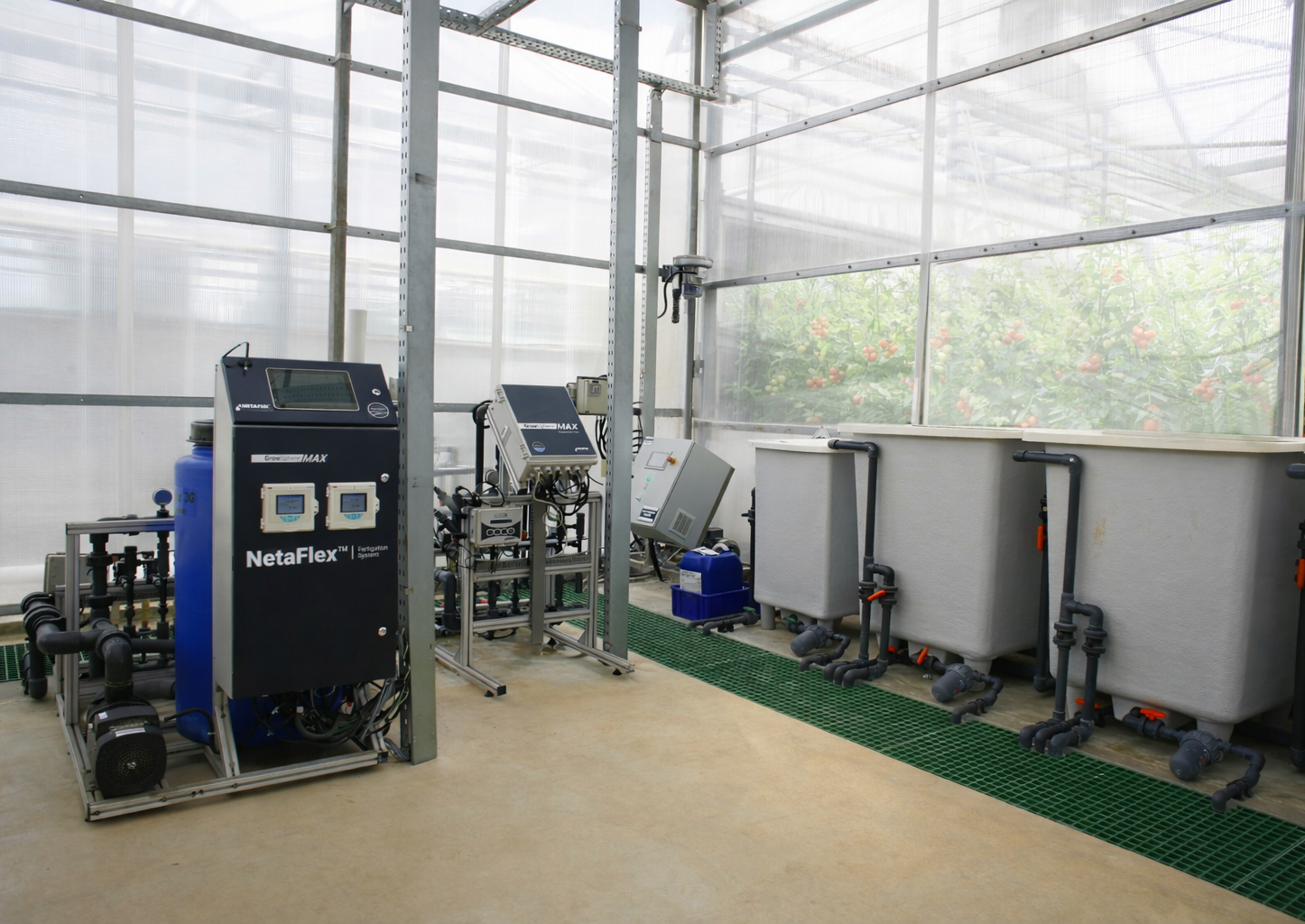
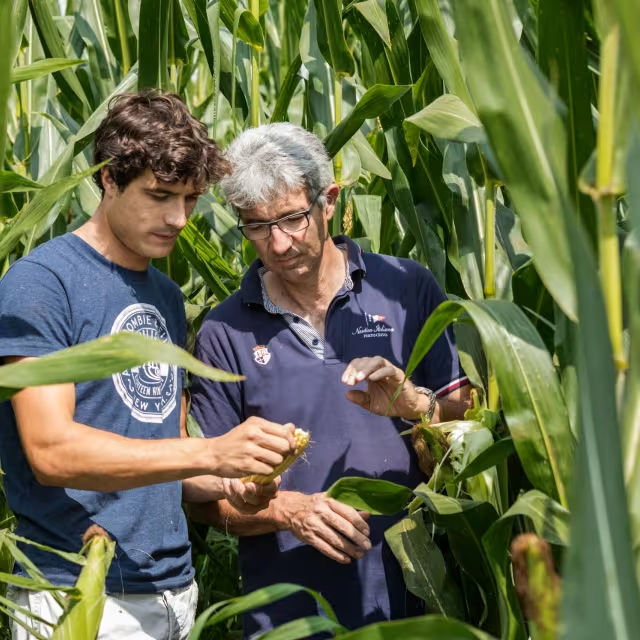
Photo credit : Netafim - "Drip irrigation was the key driver behind the transition to precision irrigation"
Integrated irrigation and fertigation management helps answer a basic need: fewer disconnected systems, better visibility into what is happening in the field, and greater confidence that water and nutrients are being applied in a coordinated way.
Recent research points in the same direction. A review published in Applied Water Science highlighted the benefits of coordinating water and nutrient management around crop demand rather than treating them as separate agronomic decisions.
Industry efforts have increasingly reflected this shift. Work conducted by Netafim on precision fertigation and water-use efficiency has focused on helping growers manage irrigation and nutrition as interconnected parts of the same agronomic system rather than as separate operational tasks.
Yet innovation alone is not enough if systems cannot perform reliably in the field. That reliability is non-negotiable, whether the challenge is dust, heat, humidity, inconsistent connectivity, or long operating hours.
Turning fertilizers uncertainty into better control
As fertilizer becomes more costly and less predictable, growers will need tools and solutions that help them apply nutrients with greater accuracy and less waste. Precision fertigation gives them a way to turn uncertainty into better control, not by using less fertilizer at any cost, but by using fertilizer more effectively.
Fertigation changed how nutrients are delivered. The next step is to change how they are managed. In a market defined by volatility and tighter margins, that shift is no longer optional. It is becoming central to the future of efficient, resilient farming.