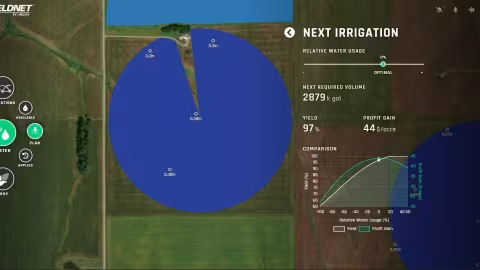
Artificial intelligence (AI) is reshaping irrigation management across Europe by integrating machine-learning forecasts, satellite and uncrewed aerial vehicle (UAV) observations, and Internet of Things (IoT) sensor networks. Reported water savings commonly range from 20% to 40%, but effects depend on crop, climate, irrigation method, baseline practice, and validation design.
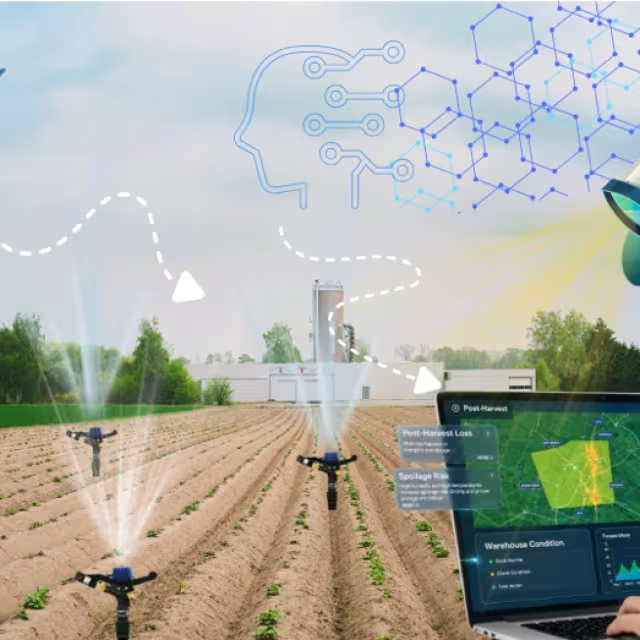
Applications now span open-field crops, protected cultivation, and urban green spaces. Wider deployment is constrained by fragmented datasets and platforms, limited interoperability, high initial and maintenance costs, uneven rural connectivity, shortages of digital skills, and inconsistent policy support.
1 - Artificial Intelligence (AI) for Precision Irrigation
AI applications in precision irrigation can be organized into three linked stages of the decision chain: (i) prediction of evapotranspiration and crop water demand, (ii) observation of crop and soil water status, and (iii) automated scheduling and control.
1.1- Predictive Modeling: LSTM and Gradient-Boosted Algorithms
Using FAO-56 Penman–Monteith reference evapotranspiration (ET₀) as the benchmark, Ayaz et al. [2] compared Long Short-Term Memory (LSTM), Gradient Boosting Regressor (GBR), Random Forest (RF), and Support Vector Regression (SVR) models at Hyderabad (India) and Waipara (New Zealand). With all meteorological inputs, LSTM achieved validation R² values of 0.99 at both stations, with root-mean-square errors (RMSEs) of 0.11 and 0.07 mm d⁻¹, respectively. Performance declined when inputs were restricted; for example, with temperature and wind speed only, validation R² decreased to 0.60 at Hyderabad and 0.37 at Waipara [2]. LSTM is a recurrent neural-network architecture designed for sequential data. Its gated memory enables the model to retain informative temporal patterns, such as antecedent weather and seasonality, while attenuating irrelevant signals. This makes LSTM suitable for daily or multi-day ET₀ forecasting when sufficiently representative time-series data are available.
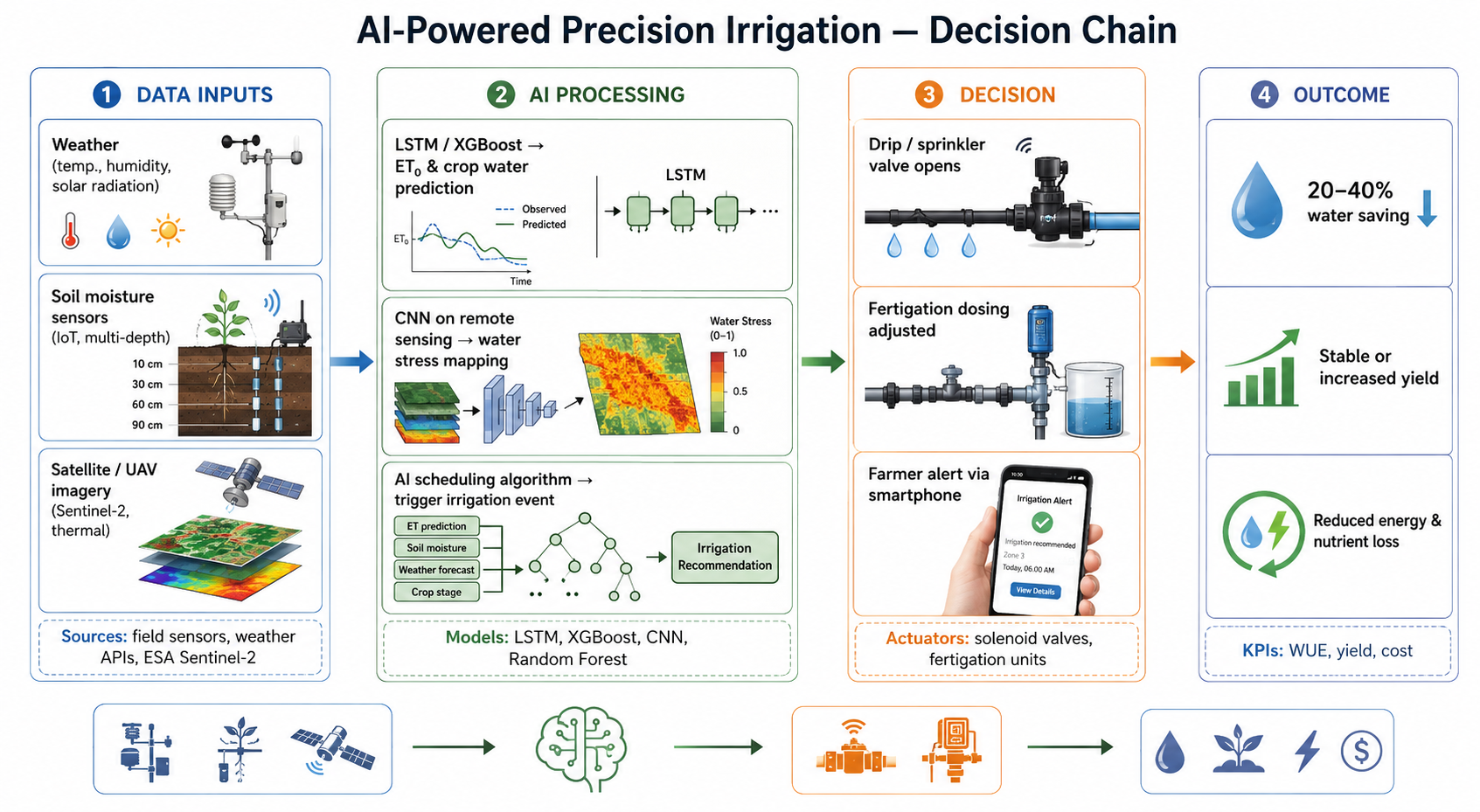
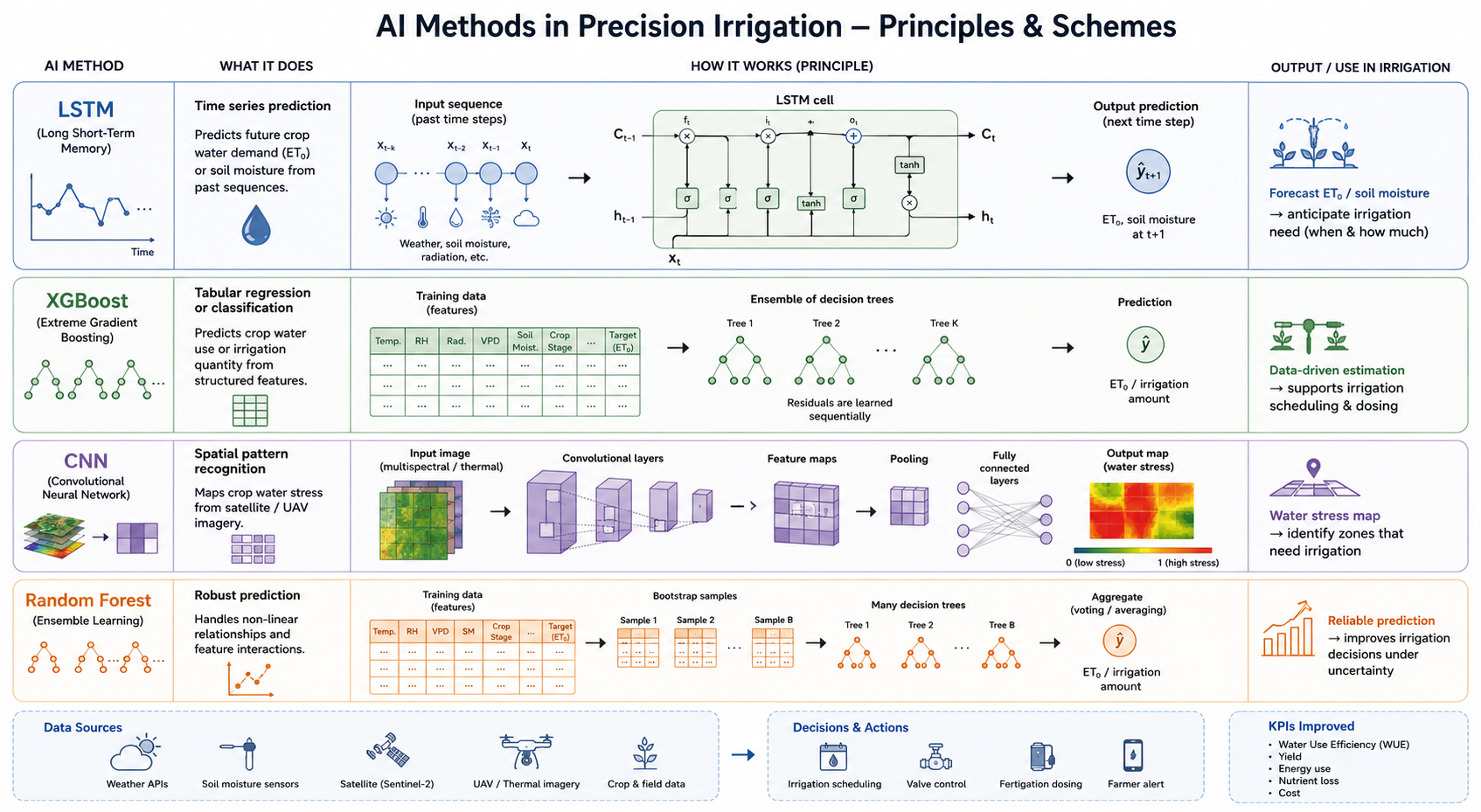
Gradient-boosted tree models, including XGBoost, offer a complementary approach. They sequentially combine decision trees so that each new tree reduces residual errors from the preceding ensemble. Inputs can include air temperature, relative humidity, solar radiation, wind speed, soil water status, and crop-development stage. XGBoost supports sparse inputs, nonlinear interactions, regularization, and predictor-importance analysis, making it useful for heterogeneous agronomic datasets [3,4]. Nevertheless, apparent resistance to overfitting does not remove the need for independent validation, careful hyperparameter tuning, and testing across sites and seasons.
Before operational deployment, sensor and meteorological inputs should be calibrated, time-synchronized, screened for implausible values and drift, and compared with independent field observations. Model validity should also be checked against the climatic, soil, crop, and management ranges represented in the training data. During exceptional conditions such as heatwaves, the system should detect out-of-distribution inputs, assimilate the most recent field and weather observations, update forecasts more frequently, and report prediction uncertainty. When uncertainty exceeds a predefined threshold, a conservative rule-based schedule or expert review should override fully automated recommendations until the model is recalibrated or retrained with representative extreme-event data [5].
1.2 - Remote Sensing: Satellites and Uncrewed Aerial Vehicles (UAVs) Combined with CNNs
Remote sensing provides spatially explicit inputs for AI-based crop-water-stress monitoring. Multispectral imagery from the Copernicus Sentinel-2 mission is freely available at 10 m spatial resolution in selected bands, with a nominal five-day revisit for the two-satellite constellation [6]. This resolution is useful for monitoring many commercial fields, although it is less suitable for very small or highly heterogeneous parcels. Recent studies combine satellite or UAV observations with machine- and deep-learning methods to estimate crop water content, canopy condition, and water stress. For example, Sentinel-1 and Sentinel-2 data have been used to estimate winter-wheat crop water content [7], while UAV multispectral and thermal imagery has been used to diagnose water stress in winter wheat [8]. Spectral bands, red-edge and vegetation indices, canopy temperature, and crop water stress indices are derived from these observations and analyzed using convolutional neural networks (CNNs), ensemble methods, or other machine-learning algorithms. CNNs learn spatial patterns within images, whereas 3D-CNNs and related spatiotemporal architectures analyze image sequences to track the development of crop stress [9]. Thus, the integration of Sentinel-2, UAV, and ground observations provides a practical framework for mapping crop water stress.
Field implementation remains data intensive. Cloud and shadow contamination, revisit gaps during rapidly developing stress, mixed pixels, cross-sensor radiometric differences, UAV flight restrictions, computational demand, and limited ground-truth observations can reduce reliability. Mitigation measures include combining optical imagery with cloud-penetrating Sentinel-1 radar, fusing satellite, UAV, weather, and soil-sensor data, automating quality control and atmospheric correction, using lightweight or edge-deployed models, and producing uncertainty maps validated against representative field measurements [1,7,8, 10].
1.3 - Automated Scheduling: IoT Sensor Network and AI Decision Systems
Automated scheduling links field measurements and forecasts to irrigation-control actions. Multi-depth soil-moisture sensors continuously characterize root-zone water status, while weather services provide short-range forecasts, typically over the next 24–72 h. AI or rule-based decision layers convert these streams into recommendations for irrigation timing and depth and, where automation is permitted, trigger pumps or valves [11].
Operational weaknesses include sensor drift and poor soil-specific calibration, non-representative sensor placement, battery or communication failure, forecast error, proprietary data protocols, cybersecurity risks, and mechanical failure of pumps or valves. Robust systems therefore require strategically replicated sensors, periodic calibration and maintenance, plausibility checks, open communication standards, local fail-safe control, and manual override. Recommendations should also be constrained by irrigation-system capacity, soil infiltration, rooting depth, and water-allocation rules [10,11].
2. AI-Integrated Irrigation Applications in Field Crops, Greenhouses, and Landscaping
Across Europe, AI-enabled irrigation is being applied in open-field agriculture, protected cultivation, and urban landscapes. In field systems, multi-depth soil-moisture measurements combined with short-range weather forecasts can reduce or postpone irrigation when rainfall is likely and increase irrigation during periods of high evaporative demand. Reviews report water savings of approximately 20–40% relative to conventional scheduling in some settings, but these values are not universal and depend on the comparator, irrigation technology, crop, soil, climate, and whether yield was maintained [1,12].
The Comunidad de Regantes del Canal Alto de Villares in Spain provides a large-scale example. The 2,500-ha system integrates 69 soil-moisture stations, five rain gauges, meteorological and water-quality monitoring, Copernicus crop observations, drone validation, and a decision-support system. The provider reports potential—not yet independently verified—water savings of up to 25% [13]. IRRISAT, which operates in the Campania region of southern Italy, supplies daily irrigation-requirement maps with weather forecasts up to five days ahead and satellite-based canopy updates every 5–10 days [14,15].
AI/IoT-driven irrigation has also been evaluated in protected cultivation. In Greek strawberry greenhouses, an edge-computing architecture used local sensor data to control irrigation and was compared with farmer-managed conventional irrigation. The authors reported lower water consumption and more stable soil moisture under the smart system but did not provide a single percentage improvement; therefore, no numerical effect size should be inferred [16].
In urban landscaping, smart irrigation is already being applied in European cities. In Barcelona, environmental measurements of humidity, salinity, temperature, wind, and soil conditions were integrated into an automated irrigation platform for parks and gardens. At the system’s launch, water savings of approximately 25% were projected; the cited source did not report this value as a measured outcome [17]. In Portugal, a garden-scale IoT study estimated theoretical water savings of up to 34.6% when real-time temperature, humidity, and soil-moisture data were combined, compared with a conventional timer-based schedule [18].
Smart irrigation can also support irrigation and fertigation of urban lawns, gardens, trees, parks, and green roofs, reduce unnecessary water use and maintenance demand while improve plant resilience.
Upscaling these examples requires a service model that does not assume end-users can install and manage the technology independently. Municipalities, irrigation communities, cooperatives, extension services, or certified providers can aggregate procurement; conduct site assessment, installation, calibration, connectivity, and maintenance; and translate complex outputs into simple, auditable irrigation alerts. Shared infrastructure, subscription or pay-per-use models, open data standards and application programming interfaces, interoperable sensors, demonstration sites, and recurrent training can reduce capital and skill barriers. Participatory co-design with farmers and landscape managers is essential to match recommendations to local practices and build trust [1,16,18,19].
3. AI-Integrated Irrigation and Sustainable Agriculture
AI-integrated irrigation can contribute to sustainable agriculture and climate-smart farming by better matching irrigation timing and depth to root-zone water status and forecast evaporative demand. Potential benefits include reduced freshwater abstraction and pumping energy, lower drainage and nutrient leaching, improved water productivity, and greater resilience to drought and heat. These systems do not necessarily increase yield in every environment; their more defensible contribution is to maintain productivity and limit yield losses when water is scarce, provided that recommendations are agronomically valid and system failures are managed. In fertigation, data-driven control can also reduce nutrient overapplication and environmental losses [1, 20].
Current uptake shows broad digital exposure but limited penetration of advanced crop technologies. In the 2025 Joint Research Centre survey of 1,444 farms in nine EU Member States, 93% used at least one general IT or software tool and 79% used at least one crop-specific digital technology. However, only 29% used three or more crop-specific tools, and adoption of individual advanced tools was generally low: satellite-derived maps were used by 22% of respondents, georeferenced soil sampling by 13%, and drones by 3%. Large farms adopted 74–84% more crop-specific digital technologies than small farms, highlighting the continuing scale and connectivity gap [19].
4.- Barriers to Adoption
Despite documented potential, uptake of AI-driven precision irrigation remains uneven across Europe. Major barriers include fragmented and weakly standardized agroclimatic, soil, and field datasets; proprietary formats and communication protocols; high upfront and recurring costs; inadequate rural connectivity; uncertainty about data ownership and sharing; and limited access to trusted technical advice and digital skills. These barriers disproportionately affect small and medium-sized farms [19, 21].
EU policy provides several enabling mechanisms but not a uniform irrigation-specific deployment pathway. Common Agricultural Policy (CAP) Strategic Plans can finance investments, advisory services, and digital or precision technologies, while the Farm to Fork Strategy promotes precision fertilization, sustainable nutrient management, and the use of Copernicus and Galileo data [22,23]. However, eligibility, co-financing, water-saving indicators, and implementation priorities differ among Member States, which can produce uneven incentives. The EU Artificial Intelligence Act establishes risk-based obligations rather than classifying all agricultural AI as high-risk; irrigation decision-support systems must therefore be assessed according to their intended use, level of autonomy, safety role, data governance, transparency, and cybersecurity requirements [24,25].
ROADMAP: Steps for AI-Powered Irrigation in Europe
1. Establish open, harmonized agroclimatic, soil, crop, and irrigation datasets across EU Member States.
2. Require interoperable sensors, open data standards, and documented application programming interfaces.
3. Co-design systems with farmers, irrigation communities, advisors, and municipalities.
4. Use transparent indicators that distinguish field-level water-use efficiency from basin-level water savings and identify where conserved water is reallocated.
5. Align CAP incentives and regional water policy with verified water-use, energy, yield, and environmental outcomes.
6. Fund cross-border validation under contrasting crops, soils, climates, and extreme events.
7. Deliver long-term training, maintenance, and advisory services for small and medium-sized farms.
8. Establish an EU-wide certification and accreditation framework covering both AI-enabled irrigation technologies and professional competencies, with independent performance assessment and accredited university, vocational, and continuing-education pathways for developers, advisors, installers, and end-users [26].
Authors : Fahad Amjad1*, Abdul Rehman 2, Muhammad Zain 3
1Department of Sustainable Agriculture and Energy, The Weihenstephan-Triesdorf University of Applied Science, Freising, Germany
2Department of Agronomy, The Islamia University of Bahawalpur, Bahawalpur, Pakistan
3Department of Plant Science, University of Bonn, Bonn, Germany
Corresponding author: fahadamjad778@gmail.com (Fahad Amjad)
References :
-
Lakhiar, I. A., Yan, H., Zhang, C., Wang, G., He, B., Hao, B., Han, Y., Wang, B., Bao, R., Syed, T. N., Chauhdary, J. N., & Rakibuzzaman, M. (2024). A review of precision irrigation water-saving technology under changing climate for enhancing water use efficiency, crop yield, and environmental footprints. Agriculture, 14(7), 1141. https://doi.org/10.3390/agriculture14071141
-
Ayaz, A., Rajesh, M., Singh, S. K., & Rehana, S. (2021). Estimation of reference evapotranspiration using machine learning models with limited data. AIMS Geosciences, 7(3), 268–290. https://doi.org/10.3934/geosci.2021016
-
Hamdaoui, H., Zarrouk, Y., Ankush, M. A. T., Al Kaddouri, H., Alzain, M. N., Noman, O., Nasr, F. A., & Kouddane, N. (2026). Accurate reference evapotranspiration estimation with limited data for sustainable irrigation in eastern Morocco: A machine learning approach. Frontiers in Sustainable Food Systems, 10, 1734366. https://doi.org/10.3389/fsufs.2026.1734366
-
Chen, T., & Guestrin, C. (2016). XGBoost: A scalable tree boosting system. In Proceedings of the 22nd ACM SIGKDD International Conference on Knowledge Discovery and Data Mining (pp. 785–794). https://doi.org/10.1145/2939672.2939785
-
Umutoni, L., & Samadi, V. (2024). Application of machine learning approaches in supporting irrigation decision making: A review. Agricultural Water Management, 294, 108710.
-
European Space Agency. (n.d.). Sentinel-2. European Space Agency.
-
Han, D., Liu, S., Du, Y., Xie, X., Fan, L., Lei, L., Li, Z., Yang, H., & Yang, G. (2019). Crop water content of winter wheat revealed with Sentinel-1 and Sentinel-2 imagery. Sensors, 19(18), 4013. https://doi.org/10.3390/s19184013
-
Wang, J., Lou, Y., Wang, W., Liu, S., Zhang, H., Hui, X., Wang, Y., Yan, H., & Maes, W. (2024). A robust model for diagnosing water stress of winter wheat by combining UAV multispectral and thermal remote sensing. Agricultural Water Management, 291, 108616. https://doi.org/10.1016/j.agwat.2023.108616
-
Sadbhave, B. L., Vaeth, P., Dejon, D., Schorcht, G., & Gregorová, M. (2025). Sugar-beet stress detection using satellite image time series. arXiv. https://arxiv.org/abs/2507.13514
-
Umutoni, L., & Samadi, V. (2024). Application of machine learning approaches in supporting irrigation decision making: A review. Agricultural Water Management, 294, 108710.
-
Zia, H., Harris, N. R., Merrett, G. V., Rivers, M., & Coles, N. (2021). An experimental comparison of IoT-based and traditional irrigation scheduling on a flood-irrigated subtropical lemon farm. Sensors, 21(12), 4175. https://doi.org/10.3390/s21124175
-
Lakhiar, I. A., Yan, H., Zhang, C., Wang, G., He, B., Hao, B., Han, Y., Wang, B., Bao, R., Syed, T. N., Chauhdary, J. N., & Rakibuzzaman, M. (2024). A review of precision irrigation water-saving technology under changing climate for enhancing water use efficiency, crop yield, and environmental footprints. Agriculture, 14(7), 1141. https://doi.org/10.3390/agriculture14071141
-
European Environment Agency, Climate-ADAPT. Improvement of irrigation efficiency.
-
KISTERS. Smart irrigation monitoring in Spain: Alto Villares case study.
-
IRRISAT. The Italian irrigation advisory service based on satellite data.
-
Angelopoulos, C. M., Filios, G., Nikoletseas, S., & Raptis, T. P. Keeping data at the edge of smart irrigation networks: A case study in strawberry greenhouses. Computer Networks, 2020.
-
BECOLVE. Intelligent irrigation in Barcelona: smart irrigation system for parks and gardens.
-
Glória, A., Dionisio, C., Simões, G., Cardoso, J., & Sebastião, P. (2020). Water Management for Sustainable Irrigation Systems Using Internet-of-Things. Sensors, 20(5), 1402.
-
Tur Cardona, J., Ciaian, P., Antonioli, F., Fellmann, T., Rocciola, F., Ierardi, I., Crimeni, R., & Anastasiou, E. (2025). The state of digitalisation in EU agriculture: Insights from farm surveys. Publications Office of the European Union. https://doi.org/10.2760/4688498
-
Umutoni, L., & Samadi, V. (2024). Application of machine learning approaches in supporting irrigation decision making: A review. Agricultural Water Management, 294, 108710.
-
OECD. (2025). AI in agriculture: Progress in implementing the European Union coordinated plan on artificial intelligence (Vol. 2). OECD Publishing. https://www.oecd.org/en/publications/progress-in-implementing-the-european-union-coordinated-plan-on-artificial-intelligence-volume-2_3ac96d41-en/full-report/ai-in-agriculture_c9ac6d24.html
-
European Commission. (2020). A Farm to Fork Strategy for a fair, healthy and environmentally-friendly food system (COM(2020) 381 final).
-
European Parliament and Council of the European Union. (2021). Regulation (EU) 2021/2115 of 2 December 2021 establishing rules on support for CAP Strategic Plans. Official Journal of the European Union, L 435, 1–186. https://data.europa.eu/eli/reg/2021/2115/oj
-
Ramon Ciutat, L. (2024, September). The Impact of the EU’s AI Act and Data Act on Digital Farming Technologies. In EPIA Conference on Artificial Intelligence (pp. 218-229). Cham: Springer Nature Switzerland.
-
European Parliament and Council of the European Union. (2024). Regulation (EU) 2024/1689 of 13 June 2024 laying down harmonised rules on artificial intelligence (Artificial Intelligence Act). Official Journal of the European Union. https://data.europa.eu/eli/reg/2024/1689/oj
-
European Irrigation Association. (2025). Position paper: Irrigation: The missing link in Europe’s Water Resilience Strategy. https://irrigationeurope.eu/en/position-paper-irrigation-the-missing-link-in-europes-water-resilience-strategy/