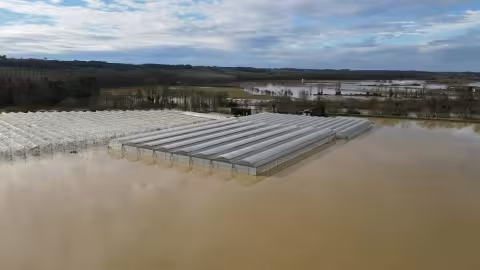
The heavy rainfall recorded in February has profoundly altered the hydrological situation in France. According to the latest bulletin from the Bureau of Geological and Mining Research (BRGM), published on March 10, these rains have led to an “exceptional” recharge of groundwater across a large part of the country, including in areas with structural deficits such as the Pyrénées-Orientales.
After several months of uncertainty regarding the state of groundwater resources, the trends observed this winter mark a clear rebalancing. The intense rainfall in February—which also caused flooding in several regions—significantly replenished the aquifers. Today, 24% of aquifers are at very high levels, an indicator deemed “exceptional” by the BRGM.
Overall, the situation is now described as “surplus” across nearly three-quarters of the region. “Only a few aquifers in the northeastern quarter still have moderately low levels, but the trend continues to improve,” the agency notes in its status report dated March 1.
A notable development for stakeholders in the water and agricultural sectors: the aquifers in the Pyrénées-Orientales, affected by several years of chronic drought, are finally showing signs of recovery. In early March, their levels rose above In early March, their levels rose above seasonal averages—a situation that had not occurred in four years.
A very active winter recharge
According to Météo-France, February 2026 was the rainiest February on record since 1959. This succession of weather disturbances led to a particularly dynamic recharge of the aquifers.
The BRGM reports that 84% of aquifers were rising in early March, compared to just 56% a month earlier. For water resource managers, this trend is a positive sign following several seasons marked by recurring water deficits.
These high levels should help alleviate water shortages in the short term. “The favorable levels currently observed should delay, or even prevent, drought conditions in the coming months,” said hydrogeologist Violaine Bault during a press briefing.
Outlook Still Dependent on Spring Rainfall
However, the winter recharge is coming to an end. As temperatures rise and vegetation begins to grow again, precipitation is now being absorbed more by the soil and plants, limiting the replenishment of groundwater.
If current trends continue, some aquifers could begin to deplete sooner than expected. The Grand-Est region, where several aquifers remain in deficit, is under particular scrutiny.
For so-called “reactive” aquifers, which fill up quickly after rainfall events, the BRGM remains relatively confident in the short term. However, spring precipitation will be crucial for maintaining above-normal levels for as long as possible.
The situation remains more uncertain for inertial aquifers, which are deeper and characterized by longer response times. In some regions, the infiltration of February’s rains is still ongoing. But for these strategic underground reservoirs, the outlook for the summer of 2026 remains difficult to predict.
In this context, the exceptional recharge observed this winter is an encouraging sign for regions and sectors heavily dependent on water resources—irrigated agriculture foremost among them—while also underscoring the need to maintain prudent management in the face of increasingly pronounced climate variability.