With the intensification of extreme weather events, the issue of water resources is becoming a major challenge for the Provence region. The demand for water for agriculture is expected to increase in the future, hence the importance of being more efficient in the use of water for irrigation. The Canal de Provence has taken this issue very seriously by developing partnerships with organizations specializing in key Provençal crops, thereby providing personalized advice to many farmers on their farming practices and irrigation management—and the results speak for themselves.
Due to climate change, two concurrent phenomena are being observed in Provence: heavier winter rainfall and rising temperatures, which are leading to reduced snowpack. Consequently, we are seeing higher flow rates in winter with well-filled reservoirs and lower inflows in summer due to reduced snowmelt.
Several solutions are being implemented to address this imbalance:
The use of alternative water resources, such as the reuse of treated wastewater and small hillside reservoirs.
Agroecology: which begins with organic farming and is also based on three key principles: crop diversification, Agroecology: which begins with organic farming and is also based on three key principles: crop diversification, the use of agroforestry, and the preservation of living soils.
Irrigation management, using soil sensors, weather stations, and high-performance software that allows us to provide plants with exactly the amount of water they need.
Optimizing water management in viticulture with Fruition Science
The Canal de Provence company has partnered with Fruition Science, which developed the 360 Viti method to help winegrowers cope with climate change.
Using soil and plant sensors linked to an agronomic platform, along with data from climate modeling, water needs are assessed in real time. Fruition Sciences’ 360viti method analyzes this data and adjusts farming practices with a common goal: to strengthen crop resilience to climate change while maintaining yields and quality.
This method first involves dividing the vine’s development into different phases, as the vine’s water needs vary significantly from one period to another:
- Period 1: Winter dormancy.
- Period 2: Budbreak, or leaf and flower development. The impact of water stress at this stage of vine development is very significant.
- Period 3: Fruit set, or vegetative growth: water stress has little impact during this phase.
- Period 4: Veraison or ripening: during the first phase of ripening or berry growth, the impact of water deficit is very significant; the grower focuses on protecting the berries from water stress. Next, just before harvest, water supply no longer affects berry development; what matters then is air quality.
- Period 5: Harvest.
Since 2020, 20 plots monitored throughout the Provence region show that with SCP support, vineyard irrigation management has improved significantly:
Water use efficiency has increased by 50% and yields are stable (±5%). Nearly half as much water is used between budbreak and harvest.
The results highlight a significant and controlled optimization of irrigation management. SCP’s support enables precision irrigation, combining reduced water inputs, stable production, and a marked improvement in water efficiency.
France Pistachio: Irrigation Optimization for the Pistachio Sector
The partnership between SCP and France Pistachio aims to better understand this new crop—the pistachio—and identify its water requirements.
The pistachio tree has very low water requirements; it will never die from a lack of water, but water scarcity can significantly impact its productivity.
Through its support program, France Pistache monitored eight plots, which enabled the gradual development of robust technical guidelines to help growers adopt optimized irrigation practices from the very start.
The plots were equipped with water meters, and three of them were additionally equipped with tensiometers, dendrometers, and weather stations to develop water balance assessments for these plots’ irrigation networks.

The results were as follows:
- Irrigation management using tensiometry to prevent water stress.
- Dendrometric data provided insights into the plants’ comfort levels.
- This helped avoid excessive irrigation, allowing for more moderate watering.
This initiative led to the publication of a guide dedicated to pistachio irrigation, promoting the dissemination of appropriate technical benchmarks to achieve technical and organoleptic excellence. The objective was to understand the water requirements of the pistachio tree at different stages of its development.
Water management of olive groves with France Olive
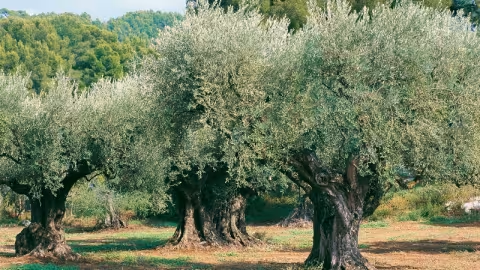
Like the pistachio tree, the olive tree is unlikely to die from lack of water. However, under water stress, the olive tree is capable of regulating its transpiration ; More specifically, it inhibits transpiration but also stunts development and growth.
Growers have come to realize the importance of irrigation, particularly due to the droughts of recent years. As a result, olive cultivation has shifted from a rain-fed system to one that relies on irrigation.
The olive tree needs water, particularly between budbreak and stone hardening (flowering to fruit set). Then, between stone hardening and lipogenesis, irrigation can be stopped, and it must be resumed at the onset of lipogenesis.
In arboriculture, research conducted with France Olive—combining various soil and plant sensors—has provided a better understanding of the link between water use and production variability, highlighting the limitations of traditional approaches based solely on water balance or soil sensors.
Two experimental plots have been monitored since 2020, using soil mapping to establish soil profiles and dendrometers—sensors that measure branch expansion (if the curve decreases, it indicates the tree is under water stress).
The initial results are encouraging: for equivalent yields, water savings of around 15 to 20% were observed on one of the plots with SCP support.
France Olive, a well-structured organization, publishes the Eau’lives newsletter every two weeks to support producers, featuring:
- Climate indicators.
- Irrigation recommendations.
- Recommendations for the period.
The SCP anticipates the consequences of global warming and supports Provençal farmers in managing their irrigation, soil, and farming practices to meet the challenge of global warming!