


For most of the 20th century, water management followed a simple logic: extract, treat, use, discharge. A linear model built on the assumption that freshwater was abundant, affordable, and reliably available.
That assumption no longer holds.
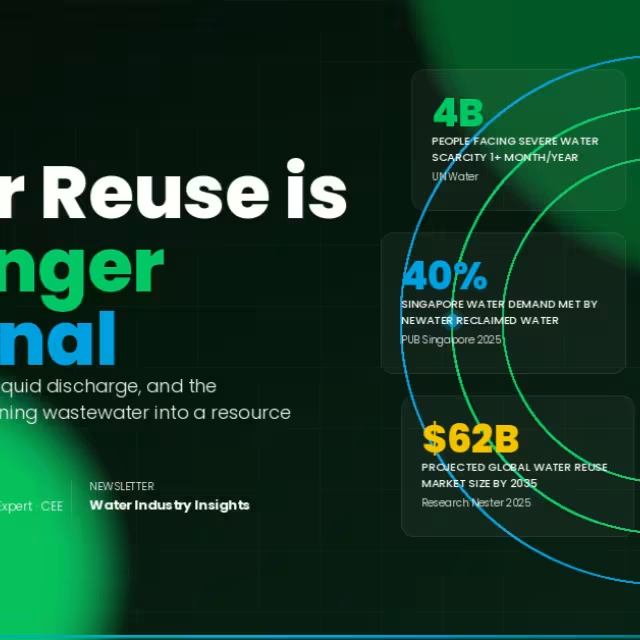
Approximately 4 billion people — more than half of the world's population — experience severe water scarcity for at least one month per year (UN Water). Climate change is tightening that pressure. And yet, the water sector continues to discharge billions of cubic metres of treated wastewater every day, instead of treating it as the resource it is.
The circular water economy is not a new concept. But in 2026, it is becoming an operational imperative — driven by regulation, economics, technology, and the undeniable arithmetic of water scarcity.
From Linear to Circular: What Has Changed
The linear model of water use — take, treat, discharge — made sense when water was cheap and regulation was light. Neither condition still applies in most markets.
The global water reuse and recycling market was valued at approximately USD 21 billion in 2025 and is projected to exceed USD 62 billion by 2035, growing at a compound annual rate above 11% (Research Nester, 2025). This is not speculative growth — it reflects real capital flowing into real infrastructure, driven by regulatory mandates, corporate sustainability targets, and the rising cost of freshwater procurement.
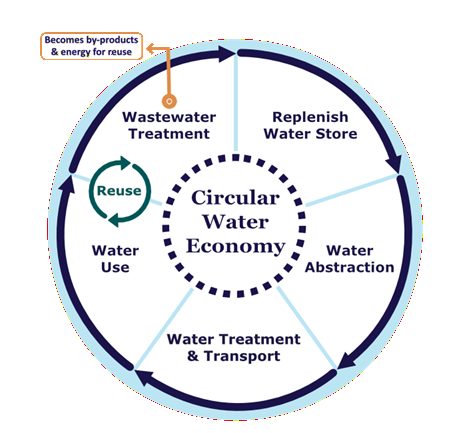
The shift is equally visible at the policy level. The EU's Regulation (EU) 2020/741 on minimum requirements for water reuse for agricultural irrigation set a binding framework for EU member states for the first time. The European Parliament projected that full implementation could enable the reuse of 6.6 billion m³ of water per year — compared to approximately 1.1 billion m³ at the time of adoption.
The direction of travel is unambiguous: water discharged without recovery is increasingly seen as a regulatory and reputational liability, not an acceptable operational outcome.
The Technology Stack: From Reclamation to Zero Liquid Discharge
Circular water management encompasses a spectrum of approaches, from basic reclamation to advanced closed-loop systems. The technology stack has matured significantly over the past decade, and the economics are shifting in favour of reuse at scale.
Indirect and Direct Potable Reuse
Singapore's NEWater programme remains the global benchmark for large-scale potable water reuse. Launched in 2003, NEWater now supplies approximately 40% of Singapore's total water demand — treated municipal and industrial wastewater processed through microfiltration, reverse osmosis, and UV disinfection to exceed WHO drinking water quality standards across over 300 monitored parameters. The programme's long-term target is to reach 55% of national water demand by 2060 (PUB Singapore).
The cost of NEWater production is below SGD 0.2/m³ — competitive with conventional supply in a city-state that imports much of its freshwater. The lesson from Singapore is not purely technical: it is institutional. Sustained policy commitment, public communication, and rigorous monitoring built the trust that made large-scale potable reuse possible.
This model is now being replicated elsewhere. The Orange County Water District (GWRS) in California operates the world's largest indirect potable reuse system, processing 265 MLD of reclaimed water for groundwater replenishment. In Europe, direct and indirect potable reuse projects are advancing in Cyprus, Spain, and Israel, where water stress levels make conventional supply insufficient.
Industrial Water Recirculation and ZLD
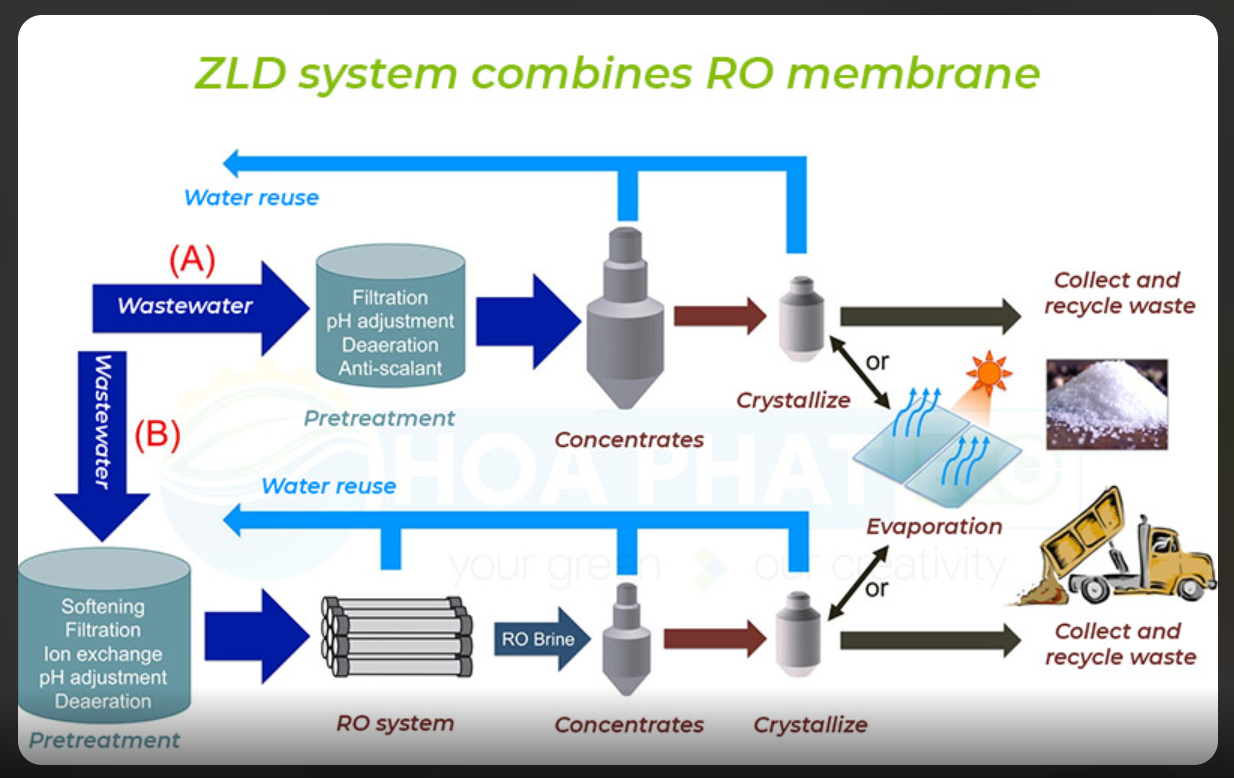
For industrial users — manufacturing, food processing, pharmaceuticals, semiconductors, power generation — water is both an operational input and a regulatory exposure. Zero Liquid Discharge (ZLD) systems have emerged as the definitive response to zero-discharge permitting requirements and escalating wastewater disposal costs.
A ZLD system processes industrial effluent through a multi-stage treatment chain — typically combining reverse osmosis, membrane bioreactors, brine concentration, and crystallisation — to recover reusable water and reduce liquid discharge to effectively zero. Residual solid waste accounts for as little as 0–5% of the original wastewater volume (Water & Wastewater Journal, 2025).
The business case is increasingly compelling:
-
Water withdrawal reduction: ZLD installations at natural gas power facilities have demonstrated reductions in freshwater withdrawal of up to 18% even at current implementation levels, with further gains achievable through system optimisation (ACS ES&T Engineering).
-
Closed-loop manufacturing: Semiconductor and electronics manufacturers — including facilities across Asia Pacific — routinely operate near-ZLD water cycles to protect both process quality and licence to operate.
-
Regulatory avoidance: In markets where discharge permits are tightening or being withdrawn, ZLD eliminates effluent liability entirely.
The Water Environment Federation (WEF) estimates that circular water approaches — including leak detection, reuse, and efficiency upgrades — represent a USD 47 billion opportunity for US utilities alone, with additional value from nutrient recovery, biogas, and managed aquifer recharge.
Agricultural Reuse: The Largest Untapped Volume
Agriculture accounts for approximately 70% of all global freshwater withdrawals. It is also the sector with the largest potential for substitution through treated wastewater reuse.
EU Regulation 2020/741 specifically targets agricultural irrigation, establishing minimum quality classes (A through D) for reclaimed water based on crop type and irrigation method. Southern and southeastern European markets — Spain, Greece, Cyprus, Italy — are leading adoption, driven by severe irrigation deficits. But the regulatory framework now applies across all EU member states, including CEE countries where agricultural water stress is increasing.
Resource Recovery: Beyond Water
The most advanced circular water economy models do not stop at water recovery. They treat wastewater as a multi-resource stream — recovering energy, nutrients, and materials alongside water.
Key streams already being recovered at commercial scale:
-
Biogas and energy: Anaerobic digestion of biosolids at wastewater treatment plants produces biogas that can generate electricity and heat, partially or fully offsetting plant energy consumption. Singapore's planned Tuas Water Reclamation Plant integrates thermal hydrolysis and enhanced anaerobic digestion to maximise energy recovery alongside NEWater production.
-
Phosphorus and nitrogen: Nutrients recovered from wastewater can be processed into fertilisers, closing the agricultural-water loop. The EU's Circular Economy Action Plan explicitly identifies nutrient recovery from wastewater as a priority.
-
Reclaimed heat: Industrial process water often carries thermal energy that can be recovered for building heating or pre-heating of incoming feedwater streams.
The WEF estimates USD 12 billion in annual value from nutrient, biogas, and biosolids recovery across US utilities — a figure that scales globally.
The CEE Dimension: Regulation, Readiness, and Opportunity
For utilities and industrial operators in Central and Eastern Europe, the circular water economy presents both a compliance timeline and a competitive opportunity.
EU Regulation 2020/741 applies across the bloc. The question for CEE utilities is not whether to implement water reuse, but how quickly and at what scale. Several structural factors shape the regional picture:
-
Water availability variability: CEE countries face increasing hydrological variability — dry summers, concentrated precipitation events, and declining groundwater levels in agricultural regions. Reuse provides a stable, climate-independent supplementary source.
-
Industrial modernisation: CEE's significant manufacturing base — automotive, chemical, food processing — is under growing pressure from international buyers and ESG investors to reduce freshwater intensity. ZLD and recirculation systems directly address this.
-
EU funding: The Recovery and Resilience Facility and Cohesion Funds include water reuse among eligible investment categories. For utilities developing bankable projects, this significantly improves the financial case.
-
Public acceptance gap: As in many regions, public perception of water reuse — particularly potable or near-potable applications — remains a barrier in CEE. Transparent communication, robust monitoring, and incremental implementation (starting with industrial and agricultural reuse) are the proven path to building acceptance.
The Strategic Shift
What distinguishes leading utilities and industrial operators today is not the decision to implement water reuse — that decision is increasingly made for them by regulation and water stress — but the speed and ambition of implementation.
The circular water economy requires a fundamental reframing: wastewater is not a waste product to be managed and discharged. It is a water resource to be recovered, a nutrient stream to be extracted, an energy source to be harvested, and a regulatory liability to be eliminated.
The technology is proven. The economics are improving. The regulation is in force.
The only variable is whether decision-makers are ready to lead that transition — or will wait until scarcity and compliance force their hand.
Dr. Jarmil Vycital | Water Engineering & GIS Expert | CEE Business Development LinkedIn Newsletter www.vycitalconsulting.com
