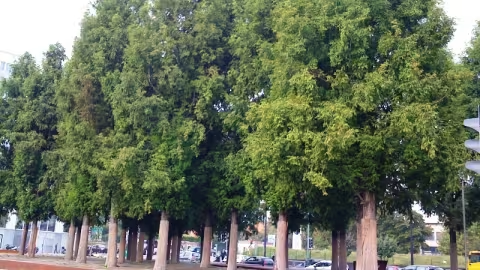

In the face of extreme heat, planting trees has become a standard practice in urban policy. But for Thomas Hanss, co-founder and technical director of Villes Vivantes, simply counting the number of trees planted isn’t enough. The real challenge lies in the trees’ living conditions: water, soil, choice of species, location, and the long term.
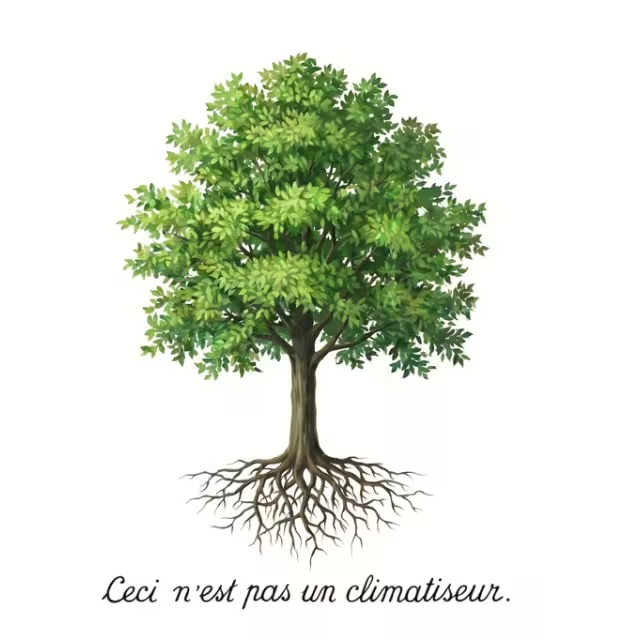
Planting trees to cool the city: the idea seems self-evident. Yet behind this intuitive equation lies a much more complex reality. Urban trees provide numerous benefits—biodiversity, stormwater management, air quality, health, and quality of life—and their cooling power is very real. But this cooling effect depends heavily on the conditions under which the tree grows.
This is the message championed by Thomas Hanss, co-founder and technical director of Villes Vivantes, who has been working on gentle densification projects for thirteen years. Starting out as a horticulturist, then a gardener, landscape engineer, and urban planner, he urges us to view the urban tree for what it truly is: a living, high-performing, yet fragile piece of infrastructure.
“Planting a tree doesn’t automatically mean you’ll get cooler temperatures,” he summarizes.
Shade Above All, Evaporation Under Certain Conditions.
In public discourse, the cooling effect provided by trees is sometimes described in dramatic terms.
One of them claims that a single tree provides as much cooling as five air conditioners. Another mentions that temperatures can drop by as much as 8 °C under a tree canopy.
For Thomas Hanss, the problem is not so much the intent behind these claims as their oversimplification. They can lead to a disregard for the technical conditions that actually determine the service provided.
The first point to clarify: under a canopy, 70 to 80% of the daytime cooling comes from the shade cast by the trees, while transpiration accounts for only 20 to 30%.
However, transpiration is directly dependent on the water available in the soil. When a tree experiences water stress, it closes its stomata—the pores on its leaves—to limit water loss. Its transpiration can then drop sharply.
A study conducted in Fribourg on twenty-two street trees (Anys & Weiler, 2025) measured a decrease in transpiration of up to 58% during drought episodes in small-leaved linden trees planted in sidewalk tree pits—where the soil beneath the canopy is nearly 90% impervious—: this is the most pronounced difference among all the sites studied. Deprived of water, the tree closes its stomata and transpires far less than the heat would otherwise require.
“Trees therefore cool us down mainly when they have the means to do so.”
This phenomenon also applies to shade. A stressed tree produces a sparser canopy, smaller leaves, and sometimes premature defoliation. It therefore intercepts less sunlight and provides less shade.
The conclusion, then, is not to plant more, but to plant and garden better.
Water, soil, and rain: the true infrastructure of the urban tree
For a tree to fulfill its role sustainably, it must first have access to the resources necessary for its growth.
This depends on the volume and quality of the soil, the absence of compaction, and also on how the city manages its stormwater. Even today, some of the rain that could nourish trees is collected and then diverted into the sewer system.
“The same impervious surface can thus either deprive a tree of water or nourish it, depending on whether the runoff is directed to the sewer or to a soak pit.”
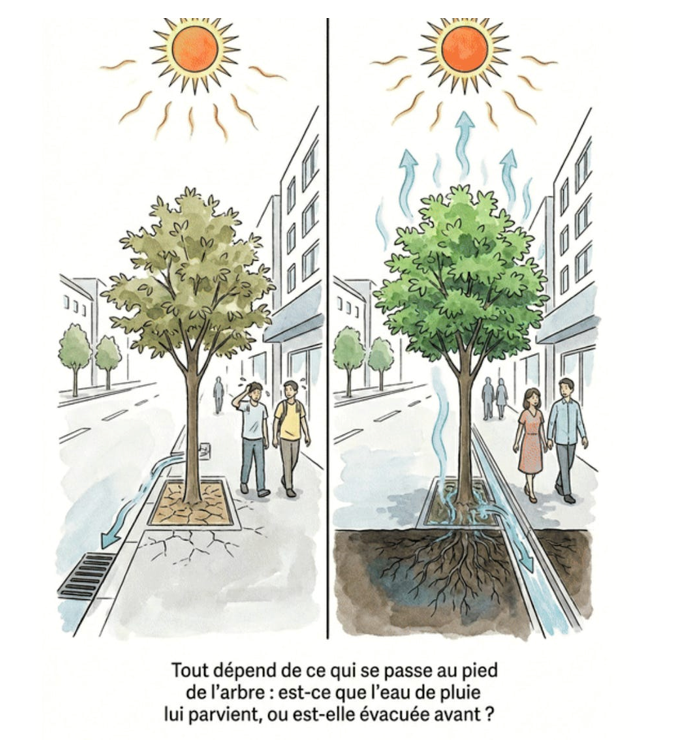
"It all depends on what's happening at the base of the tree: Is the water reaching it, or is it draining away before it do"
Three key measures therefore emerge as essential: making the area around the tree’s base permeable, providing it with sufficient soil volume, and capturing runoff from neighboring surfaces. On this last point, the results speak for themselves: connecting an impermeable surface approximately three times larger than the cistern to it provides a young tree with several thousand liters over the course of a year and eliminates up to 89% of episodes of severe water stress (Tams et al., 2024).
However, this passive irrigation does not eliminate the need for manual watering. The same studies emphasize that even the best system significantly reduces the water deficit without eliminating it entirely. During long periods without rain—and especially during the first few years after planting—water must still be provided until the root system becomes established.
In other words, greening cannot be considered in isolation from water management. Planting a tree without planning for its water supply amounts to underestimating a key part of the infrastructure necessary for its functioning.
Measuring air temperature is not enough
Another source of confusion: when we say that a tree “cools” the area, what temperature are we referring to?
The effect on surfaces—soil, walls, roadways—is particularly significant. Shade prevents these surfaces from heating up directly in the sun, and their temperature drops almost proportionally as soon as shade is added. Air temperature, on the other hand, changes much less: the small volume of cooled air around the tree constantly mixes with the surrounding hot air. Many studies that seem to prove that a few more trees make a big difference in cooling actually measure surface temperature, not air temperature.
The research also highlights a threshold effect. By conducting a detailed mapping of air temperature in Madison, United States, Ziter et al. (2019) found that a substantial cooling of the air occurs only when tree cover exceeds approximately 40 percent; below that threshold, the air temperature remains largely unchanged. The review by Alonzo et al. (2025) confirms this threshold and places it between 35% and 50%, depending on location and time of day. This threshold is by no means universal—it varies with climate and soil moisture (Beele et al., 2026)—but the principle holds true: below a certain canopy density, trees have only a minimal cooling effect on the ambient air.
At night, the phenomenon changes again. Without sunlight, the tree no longer provides its primary cooling mechanism—shade—while its stomata close and its transpiration becomes very low.
“Yet it is precisely at night that the tree cools the least. ”
In some narrow streets, a dense canopy can even trap beneath it some of the infrared radiation that the ground is trying to release, and hinder air circulation. The problem here is not the tree itself but the layout: it is the urban design that facilitates—or prevents—the ventilation that carries this heat away. When it comes to nighttime heat, the diversity of vegetation layers (lawns and shrubs provide more cooling at night) is just as important as the number of trees.
For Thomas Hanss, these limitations do not constitute an argument against trees. On the contrary, they invite us to defend trees based on all of their functions, rather than making air cooling their sole selling point.
Should we pit dense urban development against greening?
Thomas Hanss’s answer is no. The idea that “less concrete and more trees” would automatically result in a cooler environment also deserves to be qualified.
Since shade accounts for most of the cooling provided by trees during the day, it’s important to remember that buildings also provide shade.
“Framing the issue as a choice between ‘building or planting’ therefore amounts to pitting two providers of the same service against each other.”
Even more surprising is that the shade cast by buildings can actually benefit the trees themselves. By shielding the tree from some of the sun’s rays, it lowers the tree’s evaporative demand and reduces its water consumption. This is precisely what Tams and his colleagues measured in Berlin: during periods of shade, under clear skies, transpiration in street-side linden trees drops by 55 to 66 percent. The shaded tree draws more slowly on its water reserves and consequently delays the onset of its first episode of stress. Far from causing its trees to wither, a compact city can thus protect them.
The question, therefore, is not necessarily a choice between densification and greening, but rather designing both together.
However, the species must be suited to these conditions. Shade does not affect all tree species in the same way: some tolerate a lack of light better than others during drought conditions. Yang et al. (2025) demonstrated this using two contrasting species—a pine, which thrives in full sun and whose photosynthesis declines more sharply in the shade during drought; and a black locust, which is more tolerant and, on the contrary, is protected there.
“Urban shade is therefore an asset, provided that suitable species are chosen.”
The right tree in the right place rather than more trees on principle
This logic calls into question an indicator that has become commonplace in greening policies: the number of trees planted.
For Thomas Hanss, this figure says little about the actual performance of a tree-planting policy. A young tree provides little shade and must survive long enough to reach maturity.
However, the mortality rate among newly planted trees is high. The review by Hilbert et al. (2019), which compiles 56 studies, puts the median annual mortality rate at around 4 to 6.5% per year, with the highest rates occurring during the first five years. At this rate, between one-third and one-half of the planted trees could be gone after about ten years.
Hence a priority: preserving existing mature trees—which provide the bulk of a city’s canopy—whenever possible.
“Cutting down a mature tree and planting several saplings in its place does not replace it: it will take decades to restore its shade.”
Location also matters. Twenty trees scattered across twenty streets will do almost nothing to cool the air; the same twenty trees concentrated where people walk, however, will.
The true indicator, then, is not the act of planting itself, but the result achieved for residents.
Toward a New Way of Thinking About “Canopy Plans”
Does this mean we should replace the number of trees with a simple target for the percentage of tree cover? Here again, Thomas Hanss urges us not to rely on a single indicator.
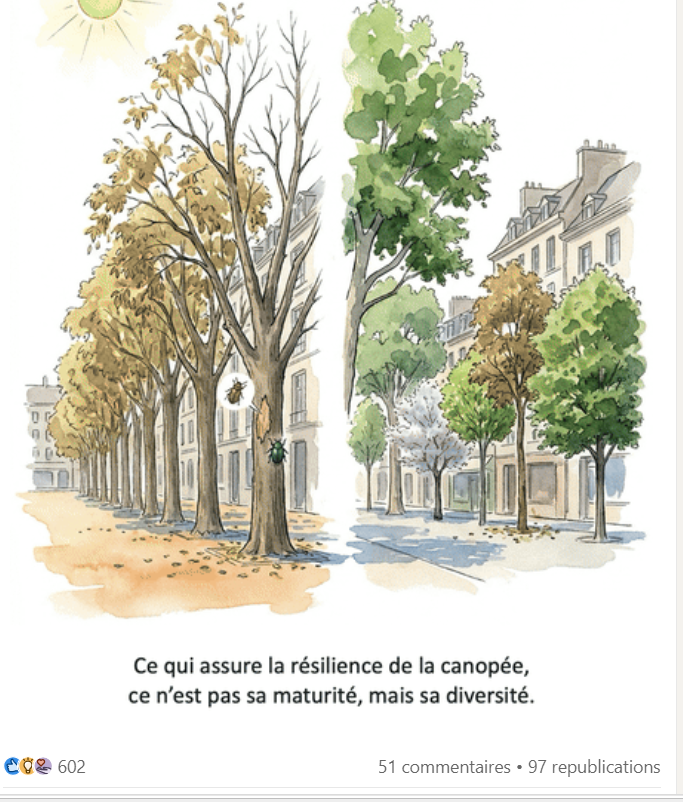
"What ensures the resilience of the canopy is not its maturity but its diversity"
Canopy cover seen from the sky does not guarantee that shade will be where it is needed. “A dense canopy over a parking lot does not provide shade for pedestrians on the sidewalk across the street.”
The location of the canopy, its density, composition, and resilience are therefore just as important as its surface area.
Species diversity, in particular, is a key factor in resilience. Canopy cover concentrated on just a few species can be vulnerable to a single threat—whether a pest, disease, or drought: the emerald ash borer in North America, or Dutch elm disease, which virtually wiped out elm trees from the French landscape starting in the 1970s, have demonstrated this. In this regard, Thomas Hanss recalls the 10-20-30 rule, formulated by Santamour: no more than 10% of a single species, 20% of a single genus, and 30% of a single botanical family. A minimum safeguard—which Paquette and his colleagues propose to go beyond by aiming for true functional diversity, that is, a variety of responses from tree species to disturbances.
“Gardening the City Over the Long Term”
Beyond the debates over indicators, the interview ultimately highlights a paradigm shift. Urban greening cannot be reduced to a planting policy. It requires a long-term strategy.
Protect existing trees. Ensure sufficient soil volume. Direct rainwater to the roots. Select tree species based on their characteristics and the climate of the future. Provide watering when necessary. And above all, give trees time to grow.
“The challenge is not to choose between building and planting, but to give trees the water, soil, and time they need to develop so they can fulfill their roles in the city as we face the heat waves to come.”
This statement sums up an approach to urban trees that goes far beyond the mere issue of providing shade. Biodiversity, water management, health, quality of life, and climate adaptation: trees can become a true part of urban infrastructure.
But living infrastructure isn’t established simply by planting a tree. It is built over time.
“Trees don’t cool the city because we plant them, but because we nurture them.”
Bibliographies :
Thomas Hanss, série « L’arbre en ville n’est pas un climatiseur miracle : 7 idées reçues à revisiter », Le guide des Villes Vivantes, 2026, https://vv.guide/larbre-en-ville-nest-pas-un-climatiseur-miracle-7-idee….
2 Thomas Hanss, « L’arbre qui résiste à la canicule est celui qui vous rafraîchit le moins », Le guide des Villes Vivantes, 26 juin 2026, https://vv.guide/larbre-qui-resiste-a-la-canicule-est-celui-qui-vous-ra….
3 Sur ces formules du discours public : Thomas Hanss, « L’arbre en ville n’est pas un climatiseur miracle : 7 idées reçues à revisiter », Le guide des Villes Vivantes, 15 juin 2026, https://vv.guide/larbre-en-ville-nest-pas-un-climatiseur-miracle-7-idee… ; et Thomas Hanss, « 1 arbre = 5 climatiseurs – Le calcul est juste. La conclusion est fausse. Voici pourquoi. », Le guide des Villes Vivantes, 26 mai 2026, https://vv.guide/1-arbre-5-climatiseurs-le-calcul-est-juste-la-conclusi….
4 Ombrage = 70-80 % du rafraîchissement sous canopée. Teri Knight et al., « How Effective Is ‘Greening’ of Urban Areas in Reducing Human Exposure to Ground-Level Ozone Concentrations, UV Exposure and the ‘Urban Heat Island Effect’? An Updated Systematic Review », Environmental Evidence 10 (2021) : art. 12, https://doi.org/10.1186/s13750-021-00226-y.
5 Baisse de transpiration de 58 % du tilleul en fosse de trottoir. Markus Anys et Markus Weiler, « Drought Impact on Transpiration Dynamics of Common Deciduous Trees Growing at Contrasting Urban Sites », Ecohydrology 18, n° 2 (2025) : e70007, https://doi.org/10.1002/eco.70007.
6 Thomas Hanss, « Stress hydrique, canicule : quand l’arbre choisit de se sauver plutôt que de nous rafraîchir », Le guide des Villes Vivantes, 17 juin 2026, https://vv.guide/stress-hydrique-canicule-quand-larbre-choisit-de-se-sa….
7 Thomas Hanss, « La ville dense condamne-t-elle vraiment l’arbre à souffrir de la soif ? », Le guide des Villes Vivantes, 23 juin 2026, https://vv.guide/la-ville-dense-condamne-t-elle-vraiment-larbre-a-souff….
8 Laura Tams, Eva Paton et Björn Kluge, « Urban Tree Drought Stress: Sap Flow Measurements, Model Validation, and Water Management Simulations », Science of the Total Environment 957 (2024) : art. 177221, https://doi.org/10.1016/j.scitotenv.2024.177221.
-9 Michael Alonzo, Peter C. Ibsen et Dexter H. Locke, « Urban Trees and Cooling: A Review of the Recent Literature (2018 to 2024) », Arboriculture & Urban Forestry 51 (2025), https://doi.org/10.48044/jauf.2025.023.
10 Carly D. Ziter et al., « Scale-Dependent Interactions between Tree Canopy Cover and Impervious Surfaces Reduce Daytime Urban Heat during Summer », Proceedings of the National Academy of Sciences 116, n° 15 (2019) : 7575–7580, https://doi.org/10.1073/pnas.1817561116.
11 Alonzo, Ibsen et Locke, « Urban Trees and Cooling » (voir note 9).
12 Eva Beele et al., « Cooling Efficiency of Urban Green Spaces Affected by Heat, Humidity and Solar Radiation », Journal of Environmental Management 407 (2026) : art. 129922, https://doi.org/10.1016/j.jenvman.2026.129922.
13 Thomas Hanss, « Plus d’arbres, moins de chaleur ? La végétalisation urbaine à l’épreuve de la science », Le guide des Villes Vivantes, 18 juin 2026, https://vv.guide/plus-darbres-moins-de-chaleur-la-vegetalisation-urbain….
14 Beele et al., « Cooling Efficiency of Urban Green Spaces » (voir note 12).
15 Thomas Hanss, « Bâtir ou planter : le faux dilemme », Le guide des Villes Vivantes, 22 juin 2026, https://vv.guide/batir-ou-planter-le-faux-dilemme-37444/.
16 Tams, Paton et Kluge, « Urban Tree Drought Stress » (voir note 8).
17 Xinbing Yang et al., « Synergistic Interactions Between Leaf Traits and Photosynthetic Performance in Young Pinus tabuliformis and Robinia pseudoacacia Trees Under Drought and Shade », Plants 14 (2025) : art. 2825, https://doi.org/10.3390/plants14182825.
18 Hanss, « Bâtir ou planter » (voir note 15).
19 Diane R. Hilbert et al., « Urban Tree Mortality: A Literature Review », Arboriculture & Urban Forestry 45, n° 5 (2019) : 167–200.
20 Thomas Hanss, « Canopée urbaine : et si on faisait fausse route en comptant les arbres ? », Le guide des Villes Vivantes, 1er juillet 2026, https://vv.guide/canopee-urbaine-et-si-on-faisait-fausse-route-en-compt….
21 Ziter et al., « Scale-Dependent Interactions » (voir note 10).
22 Hanss, « Canopée urbaine » (voir note 20).
23 Frank S. Santamour Jr., « Trees for Urban Planting: Diversity, Uniformity, and Common Sense », Proceedings of the 7th METRIA Conference 7 (1990) : 57–65 ; et Alain Paquette et al., « Praise for Diversity: A Functional Approach to Reduce Risks in Urban Forests », Urban Forestry & Urban Greening 62 (2021) : art. 127157, https://doi.org/10.1016/j.ufug.2021.127157.
24 Hanss, « Bâtir ou planter » (voir note 15).
25 Hanss, « Canopée urbaine » (voir note 20).
Sources scientifiques
Alonzo, Michael, Peter C. Ibsen, et Dexter H. Locke. « Urban Trees and Cooling: A Review of the Recent Literature (2018 to 2024). » Arboriculture & Urban Forestry 51 (2025). https://doi.org/10.48044/jauf.2025.023.
Anys, Markus, et Markus Weiler. « Drought Impact on Transpiration Dynamics of Common Deciduous Trees Growing at Contrasting Urban Sites. » Ecohydrology 18, n° 2 (2025) : e70007. https://doi.org/10.1002/eco.70007.
Beele, Eva, Raf Aerts, Maarten Reyniers, Nicole Van Lipzig, et Ben Somers. « Cooling Efficiency of Urban Green Spaces Affected by Heat, Humidity and Solar Radiation. » Journal of Environmental Management 407 (2026) : 129922. https://doi.org/10.1016/j.jenvman.2026.129922.
Hilbert, Diane R., Lara A. Roman, Andrew K. Koeser, et al. « Urban Tree Mortality: A Literature Review. » Arboriculture & Urban Forestry 45, n° 5 (2019) : 167–200.
Knight, Teri, Sian Price, Diana Bowler, et al. « How Effective Is ‘Greening’ of Urban Areas in Reducing Human Exposure to Ground-Level Ozone Concentrations, UV Exposure and the ‘Urban Heat Island Effect’? An Updated Systematic Review. » Environmental Evidence 10 (2021) : 12. https://doi.org/10.1186/s13750-021-00226-y.
Paquette, Alain, Rita Sousa-Silva, Fanny Maure, et al. « Praise for Diversity: A Functional Approach to Reduce Risks in Urban Forests. » Urban Forestry & Urban Greening 62 (2021) : 127157. https://doi.org/10.1016/j.ufug.2021.127157.
Santamour, Frank S., Jr. « Trees for Urban Planting: Diversity, Uniformity, and Common Sense. » Proceedings of the 7th Conference of the Metropolitan Tree Improvement Alliance (METRIA) 7 (1990) : 57–65.
Tams, Laura, Eva Paton, et Björn Kluge. « Urban Tree Drought Stress: Sap Flow Measurements, Model Validation, and Water Management Simulations. » Science of the Total Environment 957 (2024) : 177221. https://doi.org/10.1016/j.scitotenv.2024.177221.
Yang, Xinbing, Chang Liu, Shaoning Li, et al. « Synergistic Interactions Between Leaf Traits and Photosynthetic Performance in Young Pinus tabuliformis and Robinia pseudoacacia Trees Under Drought and Shade. » Plants 14 (2025) : 2825. https://doi.org/10.3390/plants14182825.
Ziter, Carly D., Eric J. Pedersen, Christopher J. Kucharik, et Monica G. Turner. « Scale-Dependent Interactions between Tree Canopy Cover and Impervious Surfaces Reduce Daytime Urban Heat during Summer. » Proceedings of the National Academy of Sciences 116, n° 15 (2019) : 7575–7580. https://doi.org/10.1073/pnas.1817561116.
Articles de Thomas Hanss — Le guide des Villes Vivantes
Hanss, Thomas. « L’arbre en ville n’est pas un climatiseur miracle : 7 idées reçues à revisiter. » Le guide des Villes Vivantes, 15 juin 2026. https://vv.guide/larbre-en-ville-nest-pas-un-climatiseur-miracle-7-idee….
Hanss, Thomas. « 1 arbre = 5 climatiseurs – Le calcul est juste. La conclusion est fausse. Voici pourquoi. » Le guide des Villes Vivantes, 26 mai 2026. https://vv.guide/1-arbre-5-climatiseurs-le-calcul-est-juste-la-conclusi….
Hanss, Thomas. « Stress hydrique, canicule : quand l’arbre choisit de se sauver plutôt que de nous rafraîchir. » Le guide des Villes Vivantes, 17 juin 2026. https://vv.guide/stress-hydrique-canicule-quand-larbre-choisit-de-se-sa….
Hanss, Thomas. « Plus d’arbres, moins de chaleur ? La végétalisation urbaine à l’épreuve de la science. » Le guide des Villes Vivantes, 18 juin 2026. https://vv.guide/plus-darbres-moins-de-chaleur-la-vegetalisation-urbain….
Hanss, Thomas. « Bâtir ou planter : le faux dilemme. » Le guide des Villes Vivantes, 22 juin 2026. https://vv.guide/batir-ou-planter-le-faux-dilemme-37444/.
Hanss, Thomas. « La ville dense condamne-t-elle vraiment l’arbre à souffrir de la soif ? » Le guide des Villes Vivantes, 23 juin 2026. https://vv.guide/la-ville-dense-condamne-t-elle-vraiment-larbre-a-souff….
Hanss, Thomas. « L’arbre qui résiste à la canicule est celui qui vous rafraîchit le moins. » Le guide des Villes Vivantes, 26 juin 2026. https://vv.guide/larbre-qui-resiste-a-la-canicule-est-celui-qui-vous-ra….
Hanss, Thomas. « Canopée urbaine : et si on faisait fausse route en comptant les arbres ? » Le guide des Villes Vivantes, 1er juillet 2026. https://vv.guide/canopee-urbaine-et-si-on-faisait-fausse-route-en-compt….