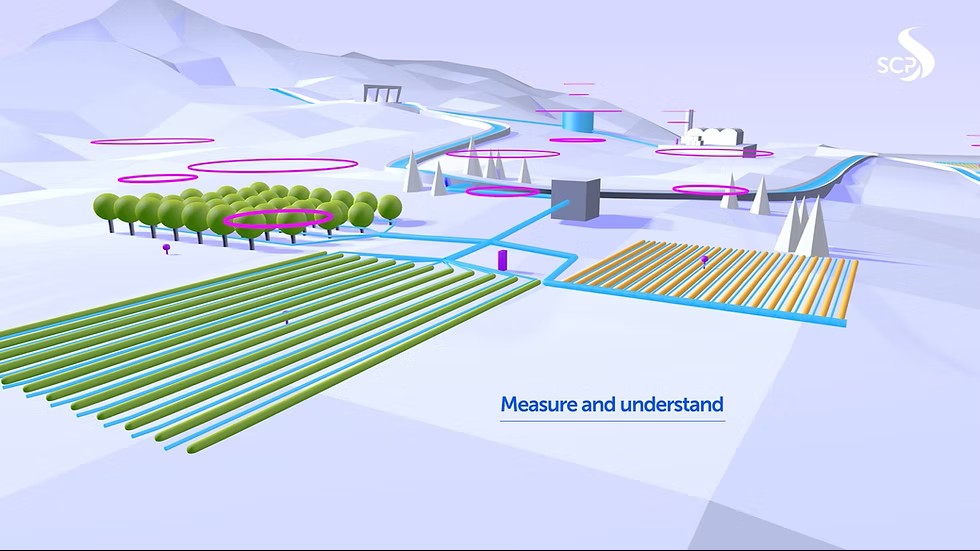

At the 26th International Congress on Irrigation and Drainage (ICID 2026), held in Marseille from October 12–17 and bringing together more than 1,000 irrigation and drainage specialists from around the world, Société du Canal de Provence (SCP) unveiled Future Hydro, an ambitious initiative designed to transform existing water distribution networks into intelligent systems capable of anticipating demand, optimizing water transfers, and reducing energy consumption. The ultimate goal is to strengthen regional resilience to climate change.

The solutions will first be tested across SCP-operated facilities before being made available to other regions facing increasing drought risks.
Seventy years ago, Société du Canal de Provence helped pioneer a regional water-sharing model across Provence. Since then, water infrastructure management has undergone three major revolutions: the introduction of pressurized water delivered on demand, dynamic network regulation, and real-time monitoring through smart meters.
The fourth revolution marks a fundamental shift from networks that simply convey water to intelligent systems capable of anticipating, simulating, and jointly optimizing water and energy use.
Through Future Hydro, SCP aims to anticipate agricultural water requirements and adapt irrigation practices to water availability, crop needs, soil conditions, and changing climatic patterns.
Rethinking Water Management in the Face of Climate Change
Future Hydro directly reflects the theme of the 26th ICID Congress: “Water and Agricultural Resilience in the Face of Climate Change.”
In the Provence-Alpes-Côte d’Azur region of southern France, temperatures have already risen by 1.5°C to 2°C compared with pre-industrial levels.
According to projections from the Explore2 research project, climate change is intensifying pressure on water resources. Rising temperatures, shifting precipitation patterns, more frequent droughts, and increasing competition among agricultural, urban, tourism, and environmental water uses are challenging traditional water management models.
These models were largely designed to respond to demand rather than anticipate it.
With expertise covering the entire water management chain—from securing regional water resources to delivering water at the individual farm level—SCP intends to transform this approach through Future Hydro and share the lessons learned with other water infrastructure operators.
From Conventional Water Networks to Smart Water Systems
By combining hydraulic modeling, digital twins, Internet of Things (IoT) technologies—including connected devices, sensors, and smart meters—real-time data, satellite remote sensing, agronomy, and energy optimization, Future Hydro aims to transform conventional water infrastructure into integrated, adaptive, and predictive regional systems.
This predictive management approach is also designed to optimize existing infrastructure, reduce energy consumption and greenhouse gas emissions, control operating costs, and minimize the need for additional infrastructure investments.
Turning Provence into a Global Testing Ground for Water Resilience
The solutions developed through Future Hydro will be tested under real-world operating conditions across SCP-managed facilities.
The results will help quantify water savings, energy performance, climate resilience and biodiversity benefits, as well as the broader impacts of optimizing water management at the regional level.
Data collected from ground-based sensors and satellite remote sensing will feed into OSIREM, SCP's decision-support platform. This system uses digital twins to model water networks and coordinate water distribution, energy consumption, and competing water uses.
Through this initiative, SCP aims to establish Provence as a pioneering region in water resilience, demonstrating how efficient, modern water management can address the growing challenges of climate change.
The experience gained will provide a replicable model for other regions facing similar pressures on water resources, both in France and across Europe and internationally.
The methods, tools, and analytical frameworks developed under Future Hydro are specifically designed for adoption by other infrastructure operators, water agencies, local authorities, and regional planners.
Future Hydro will be made available as an open-source solution
"Our networks were designed to deliver water as soon as a farmer opens a valve. With hotter, drier summers, that is no longer enough. We need to know in advance how much water each field will require and how much energy it will take to deliver it. That is the fourth hydraulic revolution," explains Julien Lecollinet, Engineering Project Director at SCP.
Six Scientific Papers Presented at the ICID Congress
As a partner of the 26th International Congress on Irrigation and Drainage, SCP introduced Future Hydro during the opening day of the event.
In addition, six scientific contributions highlighting SCP's areas of expertise were selected by the
Congress Scientific Committee for presentation during the event:
-
Integrating Earth Observation and Smart Metering to Spatialize Agricultural Water Uses in Mediterranean
-
10 Years of Using Plant Sensors to Manage Water Cycle of Mediterranean Crops
-
Agroecological Redesign of Collective Irrigation Infrastructures: A Proposal for an Analytical Framework, with Application to Case Studies
-
Scaling Up Wastewater Reuse: Lessons from REUT’O’SUD Living Labs
-
Eco-Efficiency of Different Land Use Scenarios Based on Life Cycle Assessment: Assessing if a Water Infrastructure Is an Effective Option for Securing a Region
-
Multipurpose Smart Water Networks: Leveraging IoT and Digital Technologies for Optimized Water Use and Integrated Irrigation Management
LEARN MORE ABOUT SCP | Expertise de la gestion de l'eau en France et à l'international