Drip irrigation has established itself as an essential solution for improving water efficiency, reducing inputs, and ensuring crop yields. However, like all agricultural equipment, drip irrigation tubing has a limited lifespan. At the end of the growing season, managing them becomes a major environmental and regulatory challenge.
There are drip irrigation solutions that use reusable tubing. However, these solutions remain economically unviable for many short-cycle crops. They require complex recovery, inspection, cleaning, and storage processes that are difficult to implement on a large scale. This is why the use of single-use but recyclable tubing remains the most widespread solution for many farms today.
Today, established supply chains make it possible to collect and recycle used irrigation tubing when it is properly sorted and prepared. Here’s how the supply chain works and the best practices to follow.
Single-use or reusable tubing: what’s the difference for recycling?
It is important to distinguish between two concepts that are often confused: recyclable and reusable.
The difference lies mainly in the wall thickness:
• Single-use tubing generally has wall thicknesses ranging from 100 µm to 400 µm, and they are all recyclable.
• Reusable tubes have thicker walls, ranging from 400 µm to 1.2 mm. Among these reusable tubes, those with wall thicknesses between 400 µm and 500 µm can be recycled through Adivalor, while tubes with wall thicknesses of 500 µm or greater require a specific, fee-based processing system.
Reusable tubes are designed to last several growing seasons, but require:
• monitoring of hydraulic condition
• possible chemical treatment
• careful recovery at the end of the growing season
• proper storage
Conversely, recyclable tubes are designed to be collected and recycled after use, in line with a circular economy approach.
Why recycle irrigation tubing?
Agricultural plastics account for tens of thousands of tons used each year in Europe. Among them are flexible irrigation tubes used in vegetable farming, arboriculture, and specialized crops.
When not properly collected, these tubes can:
• generate waste that is difficult to manage on the farm
• be burned or buried, which is prohibited or heavily regulated
• represent a loss of recoverable material.
On the contrary, recycling transforms this waste into a resource for the plastics industry, thereby reducing the environmental footprint of farms. Once collected, the plastic tubing is sorted, washed, shredded, and then turned into plastic pellets that will be used to manufacture new products.
This model is fully aligned with the transition toward a circular agricultural economy.
An Organized Recycling Sector in France
In France, the management of agricultural plastics is based on a collective organization structured around ADIVALOR (Farmers, Distributors, and Manufacturers for the Recovery of Agricultural Waste). This non-profit eco-organization coordinates the collection and recycling of various types of waste generated by agricultural activity, including plastics used in irrigation.
The sector operates through collaboration among several stakeholders:
• farmers, who sort and prepare the waste on-site
• agricultural distributors, who often serve as collection points
• manufacturers, who finance and support recycling efforts
• recyclers, who transform the plastics into new raw materials.
Thanks to this system, used agricultural plastics can be collected throughout France and then directed to appropriate recycling channels.
Flexible irrigation tubing is one of the types of plastic used for specialized crops that is accepted by this organization. To be accepted, it must be folded or rolled up, clean, and separated from other agricultural plastics to facilitate processing and recycling.
Flexible polyethylene drip irrigation tubes with a thickness between 100 µm and 500 µm fall under the structured recycling system, with an eco-contribution applied at the time of purchase. However, for drip irrigation tubing with a thickness greater than 500 µm, recycling is carried out through a service billed at the time of pickup. To take advantage of this service, please contact the ADIVALOR representative responsible for your region directly at https://www.adivalor.fr/contacts/index.html.
Collection is scheduled once certain volume thresholds are reached, which optimizes transportation and ensures the logistical efficiency of the system.
Conditions for recycling irrigation tubing
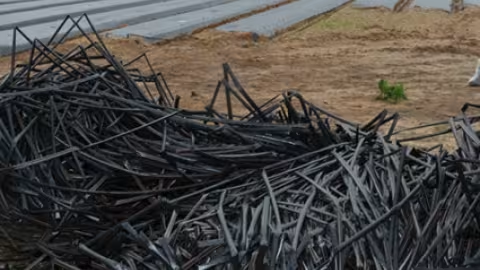
To be recycled, used flexible irrigation tubes (GSIU) must meet one essential criterion: a maximum contamination rate of 20%. In practical terms, this means that the proportion of soil, plant residues, and foreign matter must not exceed this threshold. Above 20%, recycling becomes technically more complex, processing costs increase significantly, and the batch may be rejected by the supply chain.
The tubes must be:
• as clean as possible
• free of soil and plant debris
• separated from other agricultural plastics
• rolled up or packaged for easy transport.
This step is essential, as the quality of the sorting directly affects the recyclability of the material.
A batch that is too contaminated may require special treatment or be rejected by the recycling industry.
Photo credit : Netafim - "To be recycled, used flexible irrigation tubes (GSIU) must meet one essential criterion: a maximum contamination rate of 20%"
However, certain types of waste remain excluded from the program, including:
• rigid irrigation pipes
• PVC pipes or reel components
• hoses mixed with other plastics
• hoses wound on spools.
The quality of sorting is critical, as it directly determines the technical, economic, and environmental efficiency of the entire irrigation tubing recycling sector.
Collection thresholds for irrigation tubing
To arrange for pickup, minimum quantities must generally be met.
For plastics from specialized crops, the indicative thresholds are:
• 3 tons for flexible irrigation pipes, prepared and separated from agricultural films
• grouped pickups may be possible with other agricultural waste depending on logistical arrangements.
These thresholds help optimize transportation and ensure the economic viability of recycling.
When volumes are lower, certain solutions exist:
• pooling among farms
• storage until the next growing season
• consolidation through agricultural distributors.
Best practices to adopt on the farm
To facilitate collection and maximize the chances of recycling, a few simple practices can be implemented.

What happens to the recycled irrigation tubing?
Once collected, the tubing goes through several stages:
1. sorting
2. shredding
3. washing
4. processing into plastic pellets
This recycled material is then used to manufacture new plastic products, thereby helping to reduce the use of virgin plastic.
A Major Environmental Challenge for Agriculture
The management of agricultural plastics has become a central issue for the sector’s ecological transition.
Recycling irrigation tubing helps:
• reduce plastic pollution
• limit the use of virgin plastic
• build a sustainable industrial sector.
Depending on the collection campaigns, several hundred tons of agricultural plastics can be recovered and recycled, demonstrating the industry’s growing commitment.
These results show that farmers play a key role in this effort.
Recycling irrigation tubing in Europe and around the world
The push to recycle agricultural plastics is not limited to France.
Several countries are developing similar initiatives:
• In Germany, the ERDE (Erntekunststoffe Recycling Deutschland) program is a particularly well-structured example. This national system organizes the collection and recycling of used agricultural plastics, including silage films, greenhouse films, nets, twine, and, more recently, certain irrigation tubes.
• In Italy, there is a legal obligation to recycle used tubing and it is necessary to provide proof of collection (FIR) (see the Greenfield website).
The recycling process is not organized collectively. Private collection companies are responsible for collecting the tubing and transporting it to treatment centers. Collection is billed based on various factors, including the volume of tubing to be collected and processed, and the buyback cost of the tubing. Thus, the mechanism differs from the French model: users do not pay the recycling cost upfront when purchasing the drip irrigation system, but rather pay it when using the service.
• In the United States, some states are developing voluntary collection programs, often driven by partnerships between irrigation manufacturers and recycling operators.
• In Australia, specific programs exist for agricultural plastics, particularly for irrigation and agricultural films.
Although models differ depending on regulatory and economic contexts, the trend is clear: the responsible management and recycling of agricultural plastics are gradually becoming an international standard.
This international dimension is significant. It demonstrates that the transition toward a more circular agriculture is not unique to France, but rather a global movement driven by all stakeholders in the agricultural and industrial sectors.
The role of manufacturers and industry stakeholders
Manufacturers of irrigation solutions also have a role to play in managing the end-of-life of equipment.
This involves, in particular:
• eco-design of products
• participation in recycling programs
• providing information and support to farmers on best practices.
The goal is to offer high-performance irrigation solutions while reducing their environmental impact throughout their entire life cycle.
Toward a more circular agriculture
The recycling of irrigation tubing illustrates the agricultural sector’s shift toward more responsible models.
Thanks to improved collection systems, farmer involvement, and industrial innovation, these plastics can now be given a second life.
For farmers, the challenge is twofold:
• simplify waste management on the farm
• actively participate in the ecological transition of agriculture.
With the right approach and the right partners, recycling irrigation tubing becomes a simple, effective, and beneficial practice for the entire industry. And irrigation tubes can now be given a second life.
Conclusion
The recycling of drip irrigation tubing is now a well-established, transparent, and non-profit solution that allows for a balance between agricultural performance and environmental responsibility.
Although reusable solutions exist, recyclable single-use tubing remains essential for many short-cycle crops. Thanks to the collective model led by ADIVALOR, its end-of-life process is now simple, accessible, regulated, and valorized.
By following the sorting and preparation guidelines, farmers can easily integrate this approach into their agricultural waste management.
FAQ – Recycling Irrigation Tubing
- Is drip irrigation tubing recyclable?
Yes, it is classified as recyclable agricultural plastic when properly sorted and prepared.
- Do the tubes need to be cleaned before collection?
Yes. The tubes must be cleared of as much soil and residue as possible to facilitate recycling.
- Where should used tubing be dropped off?
Generally at agricultural suppliers, during collection campaigns, or at local drop-off points.
- How much is needed for a collection?
Generally, about 3 tons of irrigation tubing prepared for collection.