Repeated droughts, with their accompanying restrictions, and warnings about groundwater pollution are convincing more and more French people to equip their homes to collect rainwater and even make it drinkable. It's a virtuous but costly and technically challenging installation.
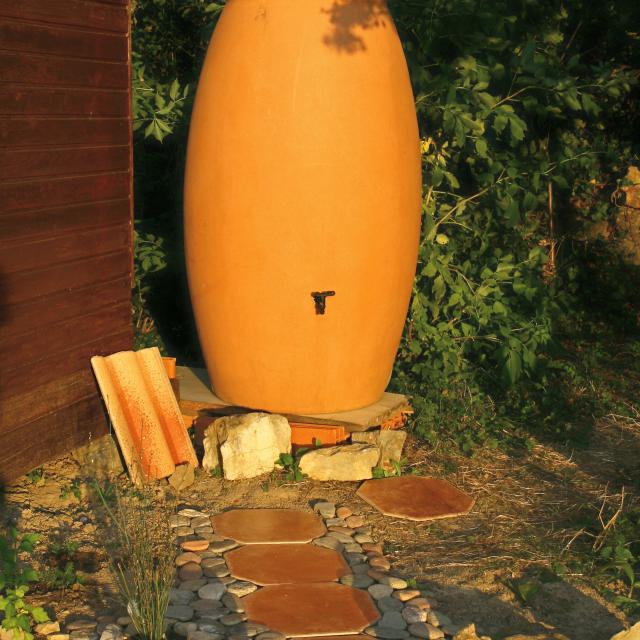
Small ones that are discreet, leaning against the wall, bulging ones spread out on the ground, giants anchored in the earth: they're all flying off the shelves! Tanks, reservoirs, cisterns, or barrels, made of plastic, rigid, flexible, or concrete, from 300 liters to 20,000 liters... Storing rainwater has become a no-brainer over the past two years. A godsend flowing from the gutters, in times of drought and inflation.
At Leroy-Merlin, “since the summer of 2022, we have seen a crazy acceleration in sales, tripling in fact, both for above-ground collectors and underground tanks, which are getting bigger and bigger.”
Rainwater collectors: how to make the right choice?
The outdoor tank is an essential part of a rainwater harvesting system. Practical and easy to install, this device allows you to water your garden at will without any impact on your water bill. It is therefore both environmentally friendly and economical.
Due to its small size, the outdoor tank is rarely used to supply sanitary facilities. However, it is quite practical for watering the lawn, garden, or flower beds; irrigating small orchards or vegetable gardens; or even cleaning the car and various gardening tools.
A rainwater harvesting system is often easy to install. This device does not require major work to modify existing drainage systems; rainwater harvesting systems are mounted directly on the downspout and collect rainwater from the roof (most of the runoff is directed to the tank). Any overflow is discharged into the gutter drain.
An outdoor tank generally has a capacity of 200 to 2,000 liters (or more, depending on the manufacturer), is made of polyethylene, a lightweight and easy-to-handle material, and comes with a coarse filter to be installed upstream of the collector, often a type of strainer installed at the top of the downspout to prevent leaves from entering the tank. Equipped with a tap, the tank distributes the collected water (the pressure comes from gravity).
Depending on the model and size, the tank may:
- have a two-inch (2") threaded connection for a tap or plug;
- be equipped with a submersible pump in - be equipped with a pump submerged at the bottom of the tank to connect a high-pressure cleaner or a garden hose;
- have a pump equipped with a level float to stop the flow as soon as the bottom of the tank is reached. The power of the pump (as well as its flow rate) must be chosen according to the capacity of the tank.
To determine the appropriate capacity, it is necessary to calculate your needs, based on a minimum volume of 1,500 liters, considering that an average of 15 liters/m² is required, bearing in mind that it is necessary to reassess the volume of the tank according to the surface area of the land.
Be sure to comply with the law: an installation error can be costly!
Rainwater harvesting is permitted in France, but strictly regulated by law. This practice has two objectives: to combat the waste of resources and to protect the health of drinking water networks.
Since the ministerial decree of August 21, 2008, the use of rainwater has been restricted to certain well-defined functions, in particular:
• Outside the building: watering green spaces, cleaning vehicles, washing private roads.
• Inside: flushing toilets and washing clothes (excluding communal laundries), subject to specific technical conditions.
Rainwater cannot be drunk or used for cooking, washing dishes, or personal hygiene (showers, baths, sinks). It must be collected only from roofs that are not accessible to the public, excluding materials containing asbestos or lead.
It must be stored in opaque, watertight tanks, protected from any external contamination. In the case of indoor use, a declaration to the local authorities is mandatory if the dwelling is connected to the public sewerage system.
French law strictly protects water networks intended for human consumption. Any connection—direct or indirect—between a rainwater network and the public drinking water network is strictly prohibited and punishable by three years' imprisonment and a €45,000 fine.
It is not necessary for contamination to be detected: the mere risk is sufficient to engage the criminal liability of the owner or installer.
Conclusion:
The outdoor tank is part of a system that collects rainwater to cover daily water needs (watering, drainage, washing, etc.). This economical and environmentally friendly solution helps reduce water bills.