
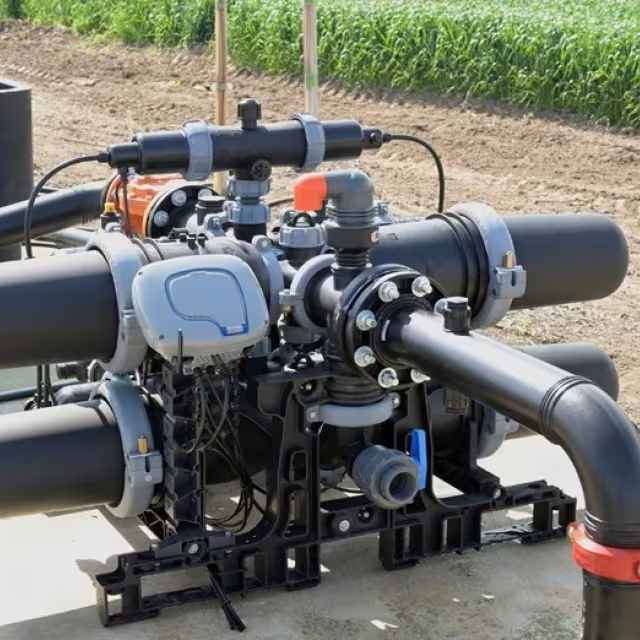
Filtration is essential for protecting all micro-irrigation systems. Efficient filtration is crucial for the longevity of the irrigation system and for maintaining long-term performance, as it prevents contaminants in the irrigation water from clogging emitters (drip emitters, spray nozzles, micro-sprinklers) and accessories.
When it comes to choosing the right filtration system, it’s a matter of making the right choice from the wide range of options available.
Different Filtration Technologies for Your Irrigation System
Sand Filtration: A Versatile Technology That Can Address Most Issues
Sand filtration is one of the most traditional and proven methods of water filtration. In this process, water is filtered through a bed of sand that traps particles and impurities. This system is effective at removing particles of various sizes and shapes, as well as a significant portion of biological particles, making it an ideal option for surface water (e.g., ponds prone to algae growth triggered by light and high surface temperatures). Furthermore, sand filtration systems are relatively well-known and simple to install and maintain, requiring little intervention and offering long-term durability. This technology is particularly well-suited for applications where water quality is variable. The distinctive feature of sand filtration is “its filtration depth.” The height of the sand within the filter creates numerous barriers to particles. As a result, the thickness of the substrate allows for the retention of finer particles such as organic matter, as well as silt and potentially some clay (when the water velocity through the filter is slow).
Disc Filtration: The perfect solution for fine filtration and minimal footprint
The principle of disc filtration involves passing water through a stack of grooved discs that trap particles suspended in the water. This technology is highly effective at removing fine particles from water, ensuring high water quality for sensitive applications such as drip irrigation and micro-irrigation. Various disc models are available, offering filtration capacity ranging from 55 to 400 µm. Additionally, disc filtration systems are compact, making them easy to install in confined spaces. Their modular design also allows for installation flexibility and adaptation to various flow rates and pressures. This technology is therefore ideal for applications requiring fine filtration and a compact footprint.
Screen Filtration: A Simple and Cost-Effective Solution
Screen filters can be used as primary or secondary filters, depending on the system.
A screen filter consists of a cylinder fitted with a screen that traps particles. This screen can have mesh sizes of various specifications, allowing for filtration fineness generally ranging from 100 to 1000 µm.
This filter is designed for water of relatively good quality. It is less commonly used for surface water (lakes, reservoirs, rivers, etc.).
This method is particularly effective at retaining large particles, thereby protecting less sensitive equipment. Additionally, screen filtration systems are often robust and easy to clean, which reduces maintenance requirements and extends the filters’ service life. This technology is therefore ideal for applications where the presence of coarse particles is common.
Hydrocyclone Sand Separator: Additional Protection for Separating Sand
Hydrocyclone sand separators are used as a preliminary filtration step when sand or heavy particles (50 microns or larger) are present in the water. They use centrifugal force to separate the particles from the water. The separated material falls into a tank or reservoir, from which it can then be removed.
This is not a true filter, since there is no physical barrier to separate the particles, but it is often used before a filter to pre-remove sand and other heavy particles present in raw water, thereby reducing the load on the main filter.
This technology is particularly well-suited for applications where the presence of sand and other solid particles is a frequent problem, such as in irrigation systems fed by groundwater sources (wells).
The hydrocyclone sand separator offers high separation efficiency with reduced maintenance.
This design reduces the time required to clean the main filter. Each hydrocyclone model has its own operating flow range and will not function above or below that range.
Professional-grade performance for a wide range of applications
Netafim France offers a broad range of filtration solutions, covering all three technologies (screen, disc, and sand), all filtration grades available on the market, and flow rates ranging from 3 to 1,500 m³/h or more. Standard models are available, but custom designs can also be manufactured (high-temperature resistance, high-pressure resistance, special coatings, specific controllers).
This unique range covers a wide variety of applications, from large-scale agriculture to parks and gardens. Whether you are involved in field crops, arboriculture, vegetable farming, or viticulture, or are seeking complementary solutions for water treatment in municipal systems or wastewater management, Netafim has the answer.
The key performance factor is an expanded effective filtration area (among the largest on the market), which, when combined with the recommended flow rate, results in one of the lowest flow velocities on the market. Combined with systems designed to perform backwashing on semi-automatic and automatic models, this gives our filters optimal overall performance.
The choice of filter must take several factors into account: water quality on the one hand, but also the requirements of your system.
Choosing a filter based on water quality:
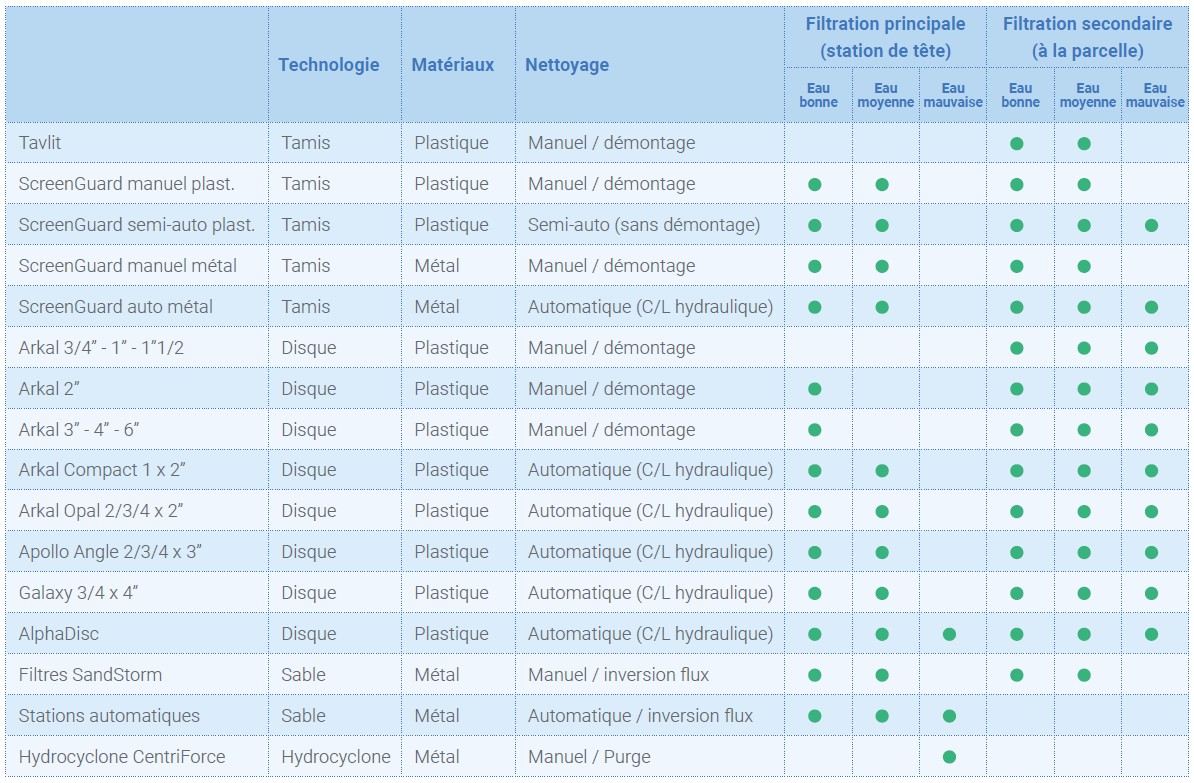
When selecting a filtration system for your irrigation system, it is crucial to consider the quality of the available water. If your water is of poor quality—meaning it contains large amounts of potentially problematic contaminants, such as sand particles or organic debris—you should consider a more efficient filtration system with a high filtration volume capable of providing significant particle retention capacity, such as sand filtration.
Here is a guide to help you choose the filter best suited for your system:
Choosing a filter based on its specifications:
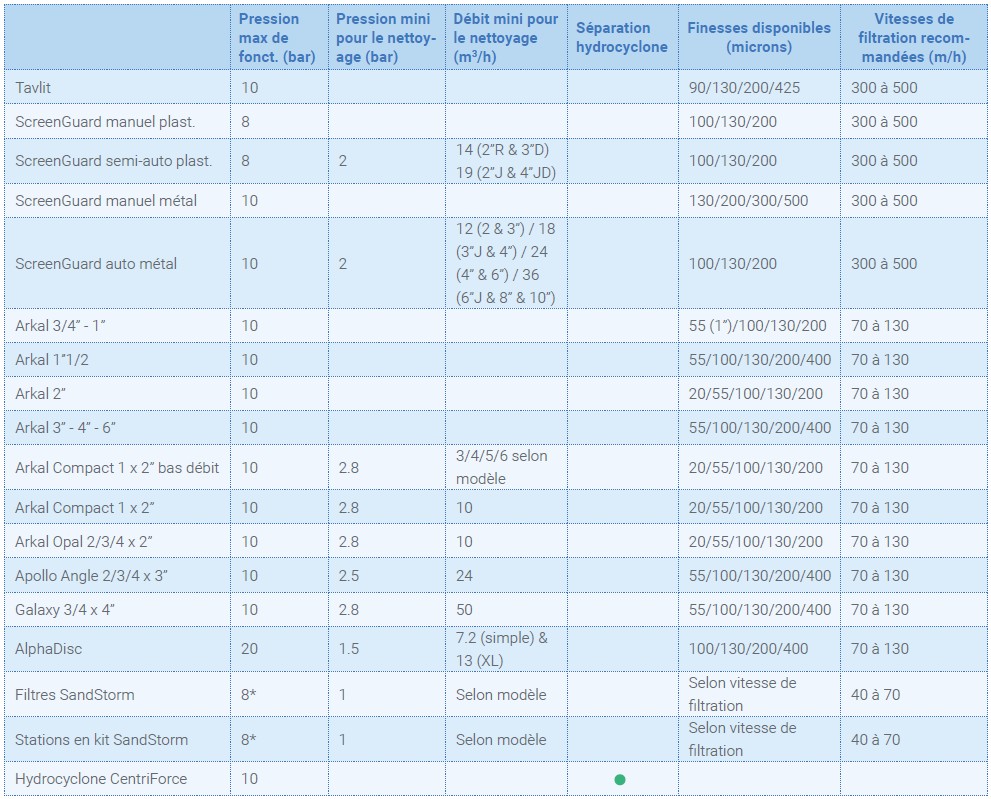
In addition to water quality, it is essential to choose a filter that meets the requirements of your irrigation system. Pressure and flow rate are critical parameters to consider, as an unsuitable filter could compromise the overall operation of the system. Furthermore, filtration fineness is a key factor, especially if your system uses sensitive equipment such as drip irrigation, which requires high-quality filtered water. Finally, filtration rate is also important, as it can influence the system’s overall efficiency and “robustness” as well as its durability. By taking these characteristics into account, you can choose the filter that best meets the specific needs of your irrigation system.
In conclusion, choosing the right filtration system for your irrigation system is essential to ensuring optimal performance and efficient water management. Netafim France offers a comprehensive range of high-quality filtration solutions tailored to a wide variety of applications, allowing you to find the solution that best suits your needs. The product line is designed to provide the best possible protection for modern micro-irrigation networks. These systems prevent drip emitters, micro-sprinklers, and even mini-sprinklers from clogging, ensuring they remain effective over the very long term. For these filtration systems to effectively fulfill their protective role, it is essential to conduct a proper assessment.
Learn more about Netafim : Netafim : Services & Solutions en Irrigation
