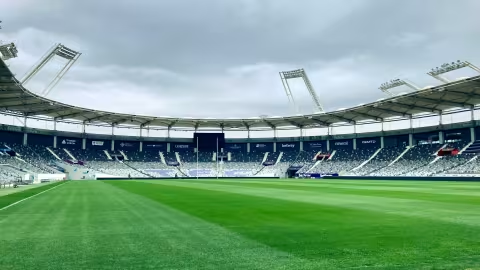
The Grand Stadium of Tangier has just been renovated in preparation for the Africa Cup of Nations. The stadium’s capacity has increased from 65,000 to 75,600 seats, the VIP areas have been modernized, and the playing fields and irrigation system have been completely renovated. This modernization aims to make it one of the premier venues for African sports, capable of hosting major competitions.
includes a tennis club, an Olympic-size swimming pool, a multi-purpose sports hall, a futsal arena, and a boules court.
Located 10 minutes from downtown and close to the airport and train station, it boasts a strategic location for hosting major national and international events. The stadium has already hosted prestigious events, such as the 2018 Supercopa de España and the 2022 FIFA Club World Cup™.
The aging stadium underwent major renovations in 2024 in preparation for the Africa Cup of Nations, which took place from December 21, 2025, to January 18, 2026. The stadium’s capacity increased from 65,000 to 75,600 seats, thanks to the addition of 5,800 seats and the lowering of the playing field by approximately 8 meters, resulting in the elimination of the athletics track. The VIP areas were modernized, optimizing the visitor experience. The playing field and the irrigation system were completely renovated.
A sophisticated irrigation system managed by the Hunter 360 controller system
The Grand Stadium of Tangier now features a main field made of hybrid natural grass, combining performance and durability to ensure optimal conditions for competitions.
The stadium is complemented by a D1-certified natural grass field and two additional natural grass fields, ideal for training and preseason matches.
The irrigation system for the main stadium has been completely redesigned. Mr. Rémi Brotons
Manager of RB Realisations, oversaw the automatic irrigation system. He has already renovated or built more than 13 stadiums in Morocco.

Photo credit : Hunter
Irrigation at the Grand Stade is managed via an ICD100 decoder system coupled with the Hunter360 Software through an ACC2 controller.
The Hunter 360 software is a comprehensive irrigation control platform. Based on mapping technology, it allows for the simultaneous control of an unlimited number of Hunter ACC2 and ICC2 controllers, as well as the weather stations assigned to the system. The new system is connected to a PC and transmits data from the weather station and soil sensors installed on the field. Based on a reliable SCADA system, the mapping platform ensures rapid decision-making and high responsiveness to environmental changes.
The irrigation system is comprised of Hunter I40 sprinklers (24 full-circle “ON” type with opposing nozzles and 24 half-circle or quarter-circle sprinklers) for a total of 48 sprinklers. The sprinklers are arranged in a square pattern to optimize irrigation uniformity.
The system is controlled by independent Hunter ICV solenoid valves for each sprinkler, allowing a specific zone to be watered without affecting the irrigation of other zones.
The water comes from the city of Tangier’s wastewater
The water used to irrigate the large stadium in Tangier comes from the city’s wastewater.
In Morocco, the issue of water has emerged in recent years as a central challenge for development. Faced with increasingly frequent droughts and growing pressure on its water resources, the country has gradually shifted its policies toward alternative solutions. Among these, the reuse of treated wastewater now plays a significant role in national water management strategies. After treatment in wastewater treatment plants, the volumes of reused wastewater remain modest on a national scale, but they are growing rapidly, driven by public policies and the need to conserve conventional resources, particularly surface water and groundwater. For now, water reuse is primarily used for irrigating urban green spaces, golf courses, and certain sports facilities, as well as for a few industrial applications; its use in agriculture remains more limited. As a result, all parks and gardens in Morocco’s major cities are watered with recycled water.
The city of Tangier is a good example of this trend. Several wastewater treatment plants located in the metropolitan area already produce treated water for watering green spaces and other non-potable uses. As a result, the water arrives at Tangier’s Grand Stadium already filtered. It simply needs to undergo a brief additional filtration process before being sent to the irrigation system. The utility room houses a filter, a Grundfos pump station, and an underground tank for water storage.
Conclusion
This winter, from December to February, Morocco experienced very frequent and intense rainfall, and the dams’ fill rate is 70%, but this is highly exceptional. In an extremely arid environment, plagued by recurring droughts for the past decade, stadium managers opted for an irrigation system that minimizes water consumption and utilizes an unconventional water source: the reuse of the city’s wastewater. Following these major renovations, the stadium is ready to host the 2030 World Cup.
Photo : Hunter - the water arrives at Tangier’s main stadium already filtered. It simply needs to undergo a brief additional filtration process before being sent to the irrigation system