Today, the importance of wastewater treatment cannot be overstated when it comes to sustainable water management. With a growing population and expanding industrial activity, the volume of wastewater being generated is reaching alarming levels.
Proper wastewater treatment is essential to remove pollutants and contaminants, protect water sources, and encourage the reuse of treated water.

However, traditional wastewater treatment methods face numerous challenges related to efficiency, cost, and environmental impact. To overcome these obstacles, innovative technologies are being developed and implemented to transform wastewater treatment processes.
The Importance of Wastewater Treatment for Sustainable Water Management
Wastewater treatment plays a crucial role in ensuring sustainable water management practices. It is essential for several reasons:
-
Environmental protection:
Wastewater contains a wide range of pollutants, including organic matter, nutrients, heavy metals, and pathogens. If discharged untreated into aquatic environments, it can contaminate rivers, lakes, and oceans, harming ecosystems and biodiversity. Proper treatment removes or reduces these pollutants, minimizing environmental impacts. -
Protecting human health:
Untreated wastewater poses a major public health risk. Pathogens found in wastewater can cause waterborne diseases such as cholera, typhoid, and hepatitis. Effective treatment processes disinfect wastewater, remove harmful microorganisms, and help ensure that the treated water is safe for various uses. -
Conserving water resources:
As water scarcity becomes an increasingly serious issue, industrial wastewater treatment can help conserve valuable resources. By treating and reusing wastewater, dependence on freshwater sources can be reduced for non-potable applications such as irrigation, industrial processes, and cleaning. This helps relieve pressure on limited water resources while promoting more sustainable water use. -
Protecting ecosystems:
The discharge of wastewater into natural ecosystems can disrupt their ecological balance. Excess nutrients such as nitrogen and phosphorus can cause eutrophication, leading to oxygen depletion and the death of aquatic organisms. Proper treatment removes these nutrients, helps protect ecosystem health, and preserves biodiversity. -
Supporting sustainable development:
Effective wastewater treatment contributes to sustainable development goals. It enables the safe discharge of treated effluent while meeting water quality standards. In addition, recovering resources from wastewater — such as generating energy from biogas or recycling nutrients for agriculture — supports the circular economy and reduces dependence on finite resources. -
Building climate resilience:
The effects of climate change, including more intense rainfall and droughts, can exacerbate wastewater management challenges. Adequate treatment infrastructure strengthens resilience to these climate-related risks by ensuring effective pollutant removal and limiting environmental damage. -
Regulatory compliance:
Governments around the world have introduced strict regulations to protect water quality and public health. Wastewater treatment is essential for meeting these requirements and avoiding penalties. By investing in appropriate treatment facilities, industries and municipalities can ensure compliance while fulfilling their environmental and social responsibilities.
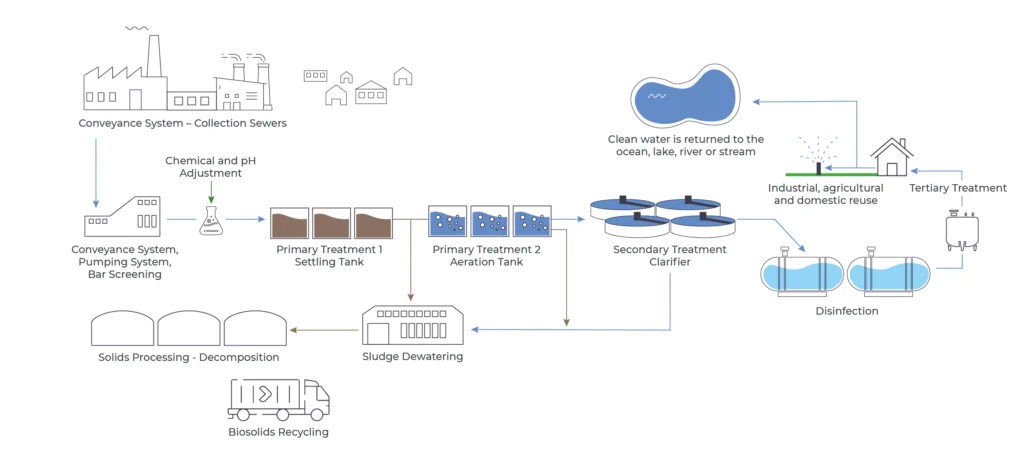
Crédit photo : Amiad - Typical wastewater treatment plant
Key Challenges in Wastewater Filtration
Wastewater filtration faces several challenges that influence the efficiency and overall performance of the treatment process.
One of the main challenges is the wide variety of contaminants found in wastewater, including suspended solids, organic compounds, heavy metals, pathogens, and emerging pollutants. Designing systems capable of effectively removing multiple types of contaminants is complex.
Another challenge is the wide range and variability of particle sizes in wastewater. Developing filtration systems that can capture particles with different sizes and characteristics is therefore essential.
Membrane fouling and clogging are also recurring problems. The accumulation of particles and organic matter gradually reduces filtration efficiency. Minimizing fouling and extending membrane life remain important priorities.
In addition, treating dissolved compounds, including dissolved organic matter and certain specific contaminants, requires additional processes beyond conventional filtration.
Energy consumption and cost are also major challenges. Wastewater filtration processes often require significant energy inputs, affecting operating costs and overall economic viability.
Scaling up and implementing filtration systems can also be difficult because of space constraints, infrastructure requirements, and the technical expertise needed to operate them.
Regulatory compliance presents another challenge, as wastewater filtration systems must meet strict water quality and discharge standards.
Addressing these issues requires ongoing research, technological innovation, and collaboration among stakeholders to improve the efficiency, sustainability, and overall performance of wastewater filtration systems.
Traditional Wastewater Treatment Methods and Their Limitations
1.Primary treatment involves removing large solids and debris from wastewater through screening and sedimentation. During sedimentation, heavier solids settle at the bottom of tanks, forming sludge that is subsequently removed.
However, primary treatment does not remove fine particles or dissolved pollutants such as organic matter and nutrients.
2. Secondary treatment relies on the biological degradation of organic matter in wastewater. Microorganisms break down pollutants through processes such as activated sludge treatment or trickling filters.
Although secondary treatment is effective at reducing organic loads, it has limitations when it comes to removing certain contaminants, including heavy metals, dissolved nutrients, and emerging pollutants.
3. Tertiary treatment adds a polishing step to further reduce remaining contaminants. It can include filtration, disinfection, and nutrient removal.
Sand filters, multimedia filters, and ultrafiltration systems can remove residual particles. Disinfection processes, including chlorination and ultraviolet treatment, are used to eliminate remaining pathogens.
4. Reverse osmosis (RO) or nanofiltration (NF) provides an additional purification stage to reduce residual microcontaminants such as microplastics and hormones.
This additional treatment has become increasingly important as regulations governing wastewater reuse and discharge become more stringent. In some cases, only part of the flow is treated before being blended with effluent from tertiary treatment.
5. Sludge treatment and disposal represent another key stage of the process. Wastewater treatment generates large quantities of sludge that must be treated or disposed of.
Sludge is often treated through anaerobic digestion, which can produce biogas, or dewatered to reduce its water content. However, sludge management and disposal continue to present both economic and environmental challenges.
6. Traditional wastewater treatment methods have limitations in terms of efficiency and adaptability. They may struggle to address certain emerging contaminants, such as pharmaceuticals, cosmetics, and microplastics, which are often not fully removed by conventional processes.
Emerging Technologies in Wastewater Treatment
Emerging wastewater treatment technologies are transforming the industry by providing more efficient, sustainable, and cost-effective solutions.
These technologies address the limitations of traditional treatment methods while improving overall treatment performance.
Membrane filtration technologies such as reverse osmosis and nanofiltration use selective membranes to remove contaminants and impurities from water.
Advanced oxidation processes, nanobubbles, and ozonation use chemical reactions to break down organic matter and eliminate pollutants.
Resource recovery technologies also make it possible to generate energy from biogas, recover nutrients such as phosphorus and nitrogen, and reuse treated water for non-potable applications.
By incorporating these emerging technologies, wastewater treatment can become significantly more efficient and sustainable while producing higher-quality treated water and improving resource management.
All of these advanced technologies rely on the integration of traditional treatment processes to achieve optimal efficiency while reducing energy and chemical consumption.
Amiad Filtration Solutions for Wastewater Treatment
Amiad’s wastewater filtration solutions use a multi-layer approach to achieve superior water quality while reducing operating costs. Amiad combines several filtration technologies, including screen, disc, microfiber, and multimedia filters, to effectively remove suspended solids, organic matter, and other contaminants. This comprehensive treatment process helps ensure that treated water meets stringent quality standards and can be safely reused or discharged.
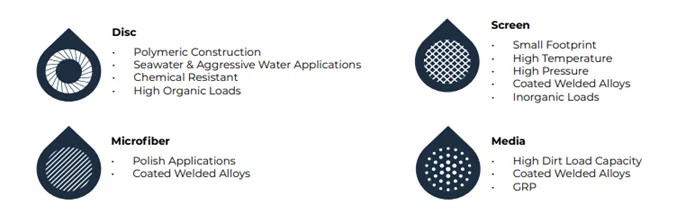
One of the key advantages of Amiad solutions is their self-cleaning mechanism, which enables continuous filtration while extending the service life of the filtration media.
The system automatically removes accumulated debris, reducing the need for manual maintenance and minimizing downtime. This feature helps improve both the efficiency and cost-effectiveness of the treatment process.
Amiad wastewater filtration systems are also designed to be compact, making them suitable for both new installations and existing treatment plants.
This adaptability enables seamless integration into different plant configurations while providing flexibility and scalability during implementation.
Amiad solutions have demonstrated their effectiveness in a variety of applications, including municipal wastewater treatment, industrial effluent treatment, and decentralized systems.
Their filtration performance, operational efficiency, and relatively low environmental impact make them a promising technology for sustainable water management.
By adopting Amiad wastewater filtration solutions and other innovative technologies, wastewater treatment plants can improve their processes, increase treated-water quality, and contribute to more sustainable resource management.
These technological advances provide a valuable opportunity to address the limitations of traditional treatment methods while helping to ensure cleaner water resources and a more sustainable future.
Conclusion
Emerging wastewater treatment technologies offer promising solutions to overcome the limitations of conventional treatment methods.
They can improve treatment efficiency, water quality, and resource recovery while supporting more sustainable water management.
By adopting and investing in these innovations, we can help pave the way toward a future focused on better water conservation, reduced environmental impacts, and improved water quality — benefiting both ecosystems and human communities.
Would you like to learn more about Amiad