
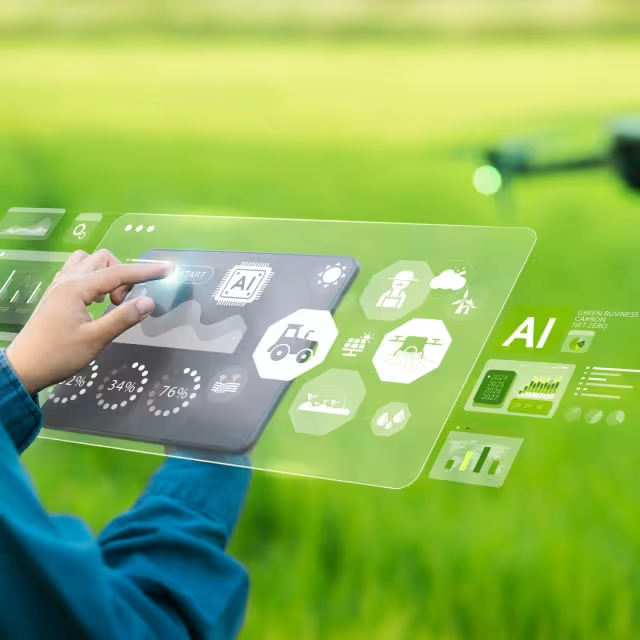
The European Irrigation Association (EIA) held its virtual Spring Irrigation Forum on Friday, 24 April 2026, welcoming irrigation and water management professionals from across Europe to discuss the role of artificial intelligence in irrigation and its contribution to water resilience, efficiency, and climate adaptation.
EIA President Moshi Berenstein opened the session, noting the Association’s continued growth to 80 members, strengthened by the addition of 14 new organisations since the last edition of the Irrigation Forum bringing innovation across digital tools, equipment, and sustainability services. The new members reflect the increasing diversity and technological advancement of the irrigation sector, with contributions spanning smart irrigation platforms, automation systems, sustainability expertise, and advanced equipment solutions.
The Forum focused on:
1. Scaling AI in Irrigation: From Data to Action – Angelo Di Mauro & Luca Incrocci (Nursy)
The presentation focused on one of the central challenges in modern irrigation: how to transform rapidly growing volumes of agricultural data into usable, automated decision-making tools. The speakers explained that today’s irrigation systems already collect extensive datasets from soil moisture sensors, weather stations, satellite imagery, and crop monitoring tools. However, this data is often fragmented across different platforms and rarely translated into clear operational guidance for farmers.
Nursy presented an AI-driven approach designed to unify these data streams into a single decision-support framework. By combining real-time inputs with historical crop behaviour and predictive modelling, the system is able to generate precise irrigation recommendations, including:
-
Optimal irrigation timing based on crop stress indicators
-
Recommended water volumes adjusted to soil and climate conditions
-
Dynamic scheduling that adapts to changing weather forecasts
The approach also reduces the cognitive burden on farmers and operators, shifting irrigation management from manual interpretation of data to automated, AI-generated actions. The speakers emphasized that this transition is essential to improving efficiency, especially in contexts where labour shortages and operational complexity are increasing.
The key message was that the future of irrigation does not depend on collecting more data, but on building systems capable of turning existing data into reliable and actionable field-level decisions.
2. Artificial Intelligence in Irrigation: The Future Beyond Remote Control – Bruno Perroni, Lindsay Corporation
Bruno Perroni presented a comprehensive overview of how artificial intelligence is reshaping irrigation systems in response to growing global pressures on agriculture. He began by outlining the main challenges currently facing the sector, including climate variability, increasing scarcity of water and energy resources, labour shortages, and the need to maintain or increase agricultural yields under more constrained conditions.
Within this context, AI is emerging as a key enabler of transition from traditional irrigation management to predictive, adaptive, and increasingly autonomous systems. The presentation showed how AI processes large volumes of real-time and historical data to generate actionable insights that guide irrigation decisions without requiring constant manual intervention.
Key applications were presented across three main areas:
-
Predictive analytics:
AI models use historical field performance, soil conditions, and environmental data to forecast irrigation needs, allowing for precise scheduling and improved water allocation. -
Crop and soil monitoring:
By combining remote sensing technologies such as drones, satellite imagery, and ground-based sensors, AI enables continuous monitoring of crop health and soil conditions. This allows early detection of stress factors such as nutrient deficiencies, pest outbreaks, or water stress. -
Weather-driven irrigation management:
Hyperlocal forecasting systems go beyond regional weather data, enabling field-specific irrigation adjustments that respond to short-term climate variations and reduce unnecessary water use.
A significant part of the presentation focused on machine health and predictive maintenance. AI systems can detect anomalies in irrigation infrastructure — such as abnormal motor load, pressure variations, or mechanical inefficiencies — before they lead to system failures. This shift from reactive to predictive maintenance reduces downtime, lowers operational costs, and ensures irrigation continuity during critical growth stages.
Finally, the importance of ecosystem integration was highlighted. Effective AI deployment in irrigation depends on collaboration between hardware manufacturers, software providers, agronomic experts, and data specialists to create a fully connected decision-making environment. Despite strong potential, several barriers were identified, including high initial investment costs, limited infrastructure in certain regions, slow adoption rates, and challenges related to data quality, cybersecurity, and regulatory frameworks.
EIA Updates
The forum also provided an update on EIA’s strategic direction and ongoing activities. In the context of the upcoming European Water Resilience Strategy, the Association is strengthening its advocacy to position irrigation as a key solution for water efficiency, climate adaptation, and food security. EIA aims to increase its visibility in EU water debates, secure recognition in policy and funding frameworks, and build a stronger investment case for sustainable irrigation. The Association continues to engage with European institutions and stakeholders to ensure that irrigation is integrated into the EU’s digital transition and future funding programmes, including the MFF 2028–2034.
The event concluded with an interactive Q&A session, where participants discussed the current capabilities of AI in irrigation, barriers to adoption, and the need to better connect innovation, policy, and investment. Discussions highlighted that while AI technologies already offer significant benefits, wider adoption will depend on improved understanding of return on investment, stronger technical capacity, and supportive policy frameworks.
For those unable to attend, the recording is available on EIA youtube channel.
https://www.youtube.com/watch?v=XvfZ-6m_RG0&t=68s