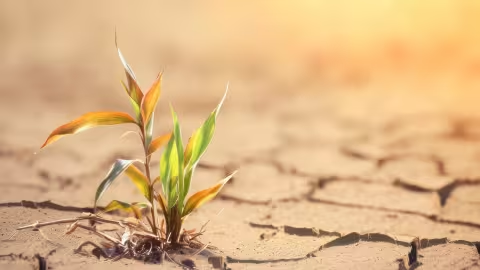
With successive heat waves and a prolonged lack of rainfall, soil moisture deficits have reached exceptional levels. The drought is spreading across France, with 98 departments now under monitoring and potentially subject to water use restrictions, according to the government website VigiEau on Monday. This marks a record since at least 2013, with the country experiencing a heat wave for the third time in less than two months.
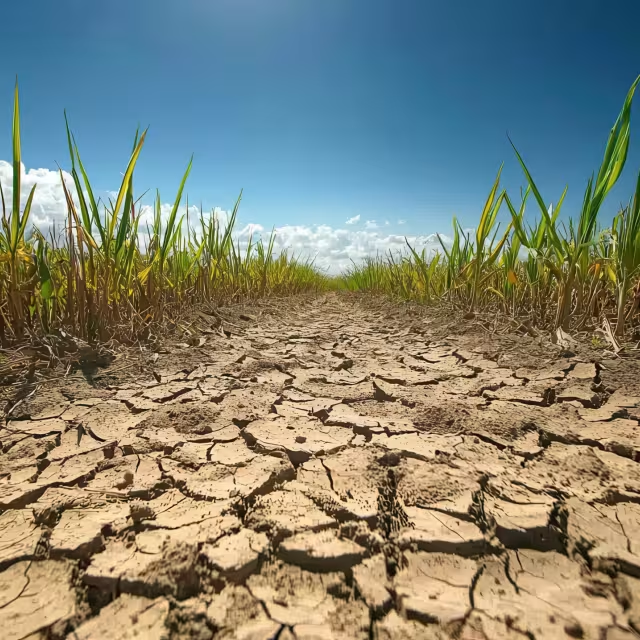
Specifically, 42 departments are in a “crisis” situation, 27 are under “enhanced alert,” and 16 are under “alert.” All of them may be subject to restrictions imposed by prefectural decrees. Thirteen others are under “vigilance,” including Paris, and are not subject to restrictions at this stage. These alerts do not automatically apply to the entire department under surveillance; in some cases, they apply only to certain areas within the department, such as in Morbihan and the Pyrénées-Orientales. In the overseas territories, Guadeloupe and Martinique are on “alert,” while Réunion is on “enhanced alert.”
A very dry start to summer
With successive heat waves and the prolonged lack of rainfall—except for a few thunderstorms,” soil moisture could reach “an exceptional level, comparable to that of the summer of 1976, a historic benchmark for drought in France,” said Cyrille Duchesne, a meteorologist at La Chaine Météo*, last week. According to him, “since June 1, rainfall has remained severely insufficient across much of the country. The few thunderstorms observed locally may have provided very temporary relief, but without any lasting improvement. They were often too isolated, too brief, or too irregular to truly replenish the soil.” Among the examples cited are cities such as Saumur, Cognac, Toulouse, Nantes, Paris, and Dijon, where the rainfall deficit sometimes reaches -60 to -80 percent.
During a press briefing on interministerial crisis management on Monday, Damien Lamotte, deputy director of the Water and Biodiversity Directorate at the Ministry of Ecological Transition, referred to “three consecutive droughts”: a soil drought “widespread across the entire country, with observable consequences for vegetation”; “demand pressure and water withdrawals from rivers,” which are also experiencing a widespread decline, and a drought “that occurs once every 20 years”; and Groundwater levels are also being monitored, as nearly all are falling and half of them were below normal as of July 1, according to the Bureau of Geological and Mining Research (BRGM).
Call for “conservation”
In response to the increasing number of departments affected by drought, the government announced on Monday that it would strengthen the national drought management system. “An interministerial directive (...) provides, in particular, for the convening of ‘water resources’ committees in each department, the rapid issuance of restriction orders as soon as thresholds are exceeded, enhanced monitoring, and weekly tracking of the situation at the watershed level,” the Ministry of Ecological Transition wrote in a press release. “Depending on the severity of the local situation, these orders may impose restrictions on agricultural irrigation, filling private swimming pools, washing vehicles, watering gardens, or certain industrial uses,” it added. 201 prefectural orders are currently in effect. Nouvelle-Aquitaine is the hardest-hit region, with 11 out of 12 departments in a state of crisis.
The aim of these measures is to “preserve access to drinking water as well as public health and civil safety services,” Damien Lamotte noted, as the government “anticipates a situation that is likely to worsen in the coming weeks, with restrictions likely to be tightened given the weather forecasts, and demand that remains very high.” Authorities are also calling for “conservation,” a message relayed by prefects in each department, with “common-sense” recommendations such as watering in the evening rather than during the day or taking showers instead of baths.
Regarding drinking water, the situation “is not, strictly speaking, cause for concern,” Damien Lamotte assured reporters during the press briefing. About 100 water distribution units (out of 16,000) are under strain nationwide. “But we must remain vigilant,” he concluded.