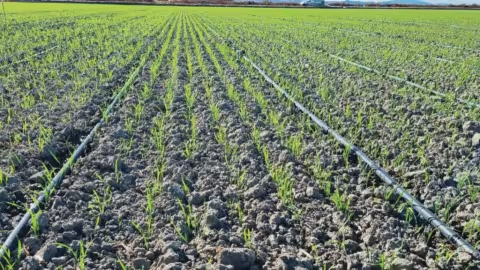
At Kenya's Ahero Irrigation Scheme, low irrigation efficiency increases nutrient and sediment runoff into the Lake Victoria . This raises risks of eutrophication in the lake. To enhance water management, the adoption of intermittent flooding and lining canals are practices taken into consideration. Water losses, protection of downstream water quality, and support for sustainable agriculture across the basin are some of the benefits gotten from these practices. Further several options related to the use of pressurized irrigation are explored in regards to their water use efficiency.
Context
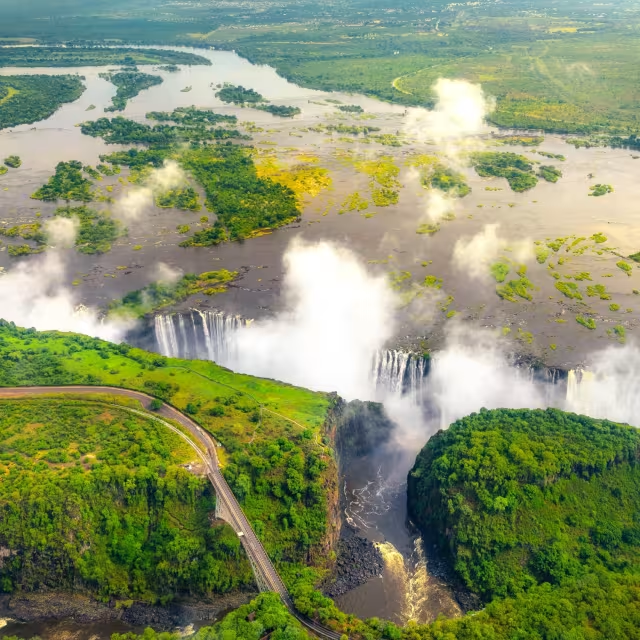
The Ahero Irrigation scheme was established in 1966 in the Kano Plains of western Kenya. The scheme spans 10,810 acres and produces 58,374 metric tonnes of rice annually. The main irrigation method used is basin irrigation which is supplied by water from River Nyando. Excess irrigation water drains from the scheme into the Nyando Wetland, eventually reaching the Lake Victoria Basin. This is a transboundary resource shared by Kenya, Uganda, Tanzania, Rwanda, and Burundi. Lake Victoria supports millions through fisheries, agriculture, and drinking water.
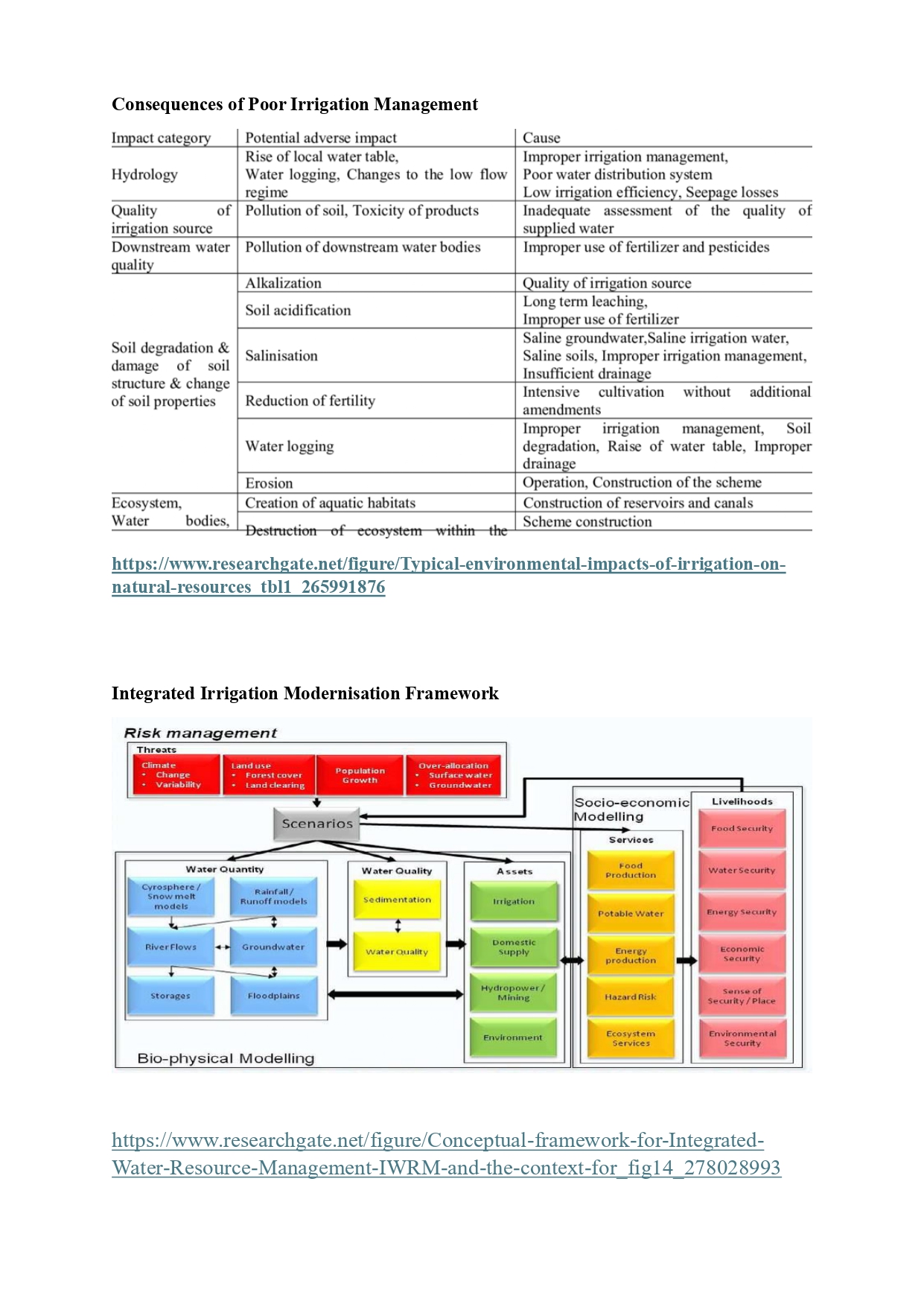
While continuous flooding irrigation supports stable rice yields at Ahero, this has resulted in low water productivity and elevated nutrient and sediment transport. This is particularly during peak irrigation and rainfall periods between March and July. The Nyando River, is recognised as a major contributor of phosphorus and sediment to Lake Victoria. This has raised concerns about nutrient enrichment and declining water quality. Observed phosphate concentrations of approximately 0.08–0.24 mg L⁻¹ have been recorded in the catchment, with the river documented as contributing substantially to the lake's phosphorus budget and generating hypertrophic conditions in receiving waters. This phosphorus does not arrive in the lake by accident as it leaves Ahero's fields. The excess water that floods beyond what the rice crop requires, carries dissolved nutrients through drainage channels into the Nyando River and onward to the lake.
Increased phosphorus and sediment levels entering Lake Victoria cause eutrophication. The excess nutrients cause rapid growth of algae and aquatic plants. Algal blooms lower water clarity, modify aquatic habitats. When the biomass decomposes, this leads to the levels of oxygen being dissolved in water to drop significantly. These changes endanger fish populations that support regional fisheries and reduce drinking water quality for lakeside communities. Lake Victoria is one of the world's largest freshwater bodies. It is vital to the East African food security and the regional economy. Managing upstream nutrient sources has become an urgent necessity.
Agrochemical use further affects local water sources in the Ahero region. Surveys have indicated that 20.8% of farmers apply the herbicide 2,4-D. There are residues detected in irrigation canals and wells of these chemicals. This occasionally exceeding thresholds recommended by the World Health Organisation for drinking water quality. These herbicide residues show that the current chemical management is a failing system. Switching to integrated pest management is an effective strategy. This reduces the probability of water being polluted while keeping weed control effective.
Options for Modernisation
Improving Efficiency at Field Level
At Ahero, rice productivity is currently 0.3406 kg per cubic metre. This trails behind more advanced irrigation systems. Significant water is lost throughout the network. Starting with the 14.3 km earthen main canal, which operates at just 83.2% efficiency. This alone accounts for a 17% loss via seepage and evaporation. Compounding the problem, the pumping stations average a mechanical efficiency of only 47%.
These combined losses occur because the earthen canals are susceptible to seepage and clogged by aquatic weeds. This slows water flow and increase evaporation. Old and vandalized control structures further hamper the system, making it nearly impossible to manage water distribution properly. At field level, poorly levelled basins mean farmers apply far more water than the crop needs simply to achieve even surface coverage. The scheme currently charges a flat fee by area instead of volume. Without water being priced by volume, farmers have no financial reason to conserve it.
The most urgent fixes are on the infrastructure side. Lining the earthen canals with an impervious layer would directly address the 17% conveyance loss. Until that full lining is done, simply clearing out aquatic weeds and fixing broken water gates is a much cheaper way to improve the system. Farmer training on proper land preparation and basin levelling techniques would reduce excessive water application at field level. Strengthening the capacity of Irrigation Water Users Associations to monitor and enforce water use. This should be done alongside a shift toward volumetric pricing. This provides the management's motive that physical upgrades alone can't provide.
From Flooding to Smart Water Use
Beyond infrastructure, there is evidence for intermittent irrigation adoption. Studies of rice water management in major rice-producing countries, including Kenya, show that replacing continuous flooding with the System of Rice Intensification (SRI). This uses alternating wetting and drying cycles which can reduce water use by 40–74% while maintaining comparable yields. SRI has already been adopted by over 10,000 rice farmers across five Kenyan irrigation schemes including Ahero itself. This has led to water savings of 25–33% recorded under controlled conditions and yield increases of 20–100% depending on variety. Research at Kenya's Mwea Irrigation Scheme confirms that Alternate Wetting and Drying (AWD) reduces greenhouse gas emissions from paddy fields while simultaneously improving irrigation efficiency. Importantly, AWD reduces phosphorus and nitrogen losses via surface runoff by 23–31% compared to continuous flooding. This directly reducing the nutrient load reaching the Nyando Wetland and Lake Victoria.
The 2025 Ahero ESIA recommanded phased implamentation. This prioritizes canal rehabilitation and farmer training in Years 1-2. This Yielding projected productivity gain of 20 - 30 % within three years while halving nutrient loads to Nyando Wetlands.
How to move forward ?
Such challenge of irrigation efficiency and agriculture runoff can be adressed through technological and policy innovations, in particular the European Copernicus Programme that support satellite-based monitoring system.
The programme uses Sentinel data to track crop water use and identify inefficient irrigation practices. When combined with precision irrigation technologies and improved canal infrastructure, these systems may help reduce again water losses and agricultural pollution.
However, there is a critical need for more advanced research to bridge the gap between European successes and African irrigation schemes like Ahero. While the raw satellite imagery is available, the quantitative data analysis such as calibrated evapotranspiration models and nutrient leaching algorithms has not been sufficiently developed and calibrated for the specific soil and climatic conditions of the Kano Plains. Incorporating more rigorous remote sensing-based analysis would move Ahero beyond simple visual mapping toward a data-driven system, allowing for the same level of precision water accounting seen in Europe.
Regarding pressurised systems, drip irrigation is actively used in Kenya but for horticulture and high-value crops in water-scarce areas not for paddy rice. The reasons are agronomic and economic. Paddy rice requires the anaerobic soil conditions that continuous flooding creates. Drip and sprinkler irrigation produce aerobic conditions, requiring different rice varieties and management, with yield trade-offs that ongoing research is working to resolve. As of 2020, the upfront cost of drip equipment ranged between 750 and 2,400 US dollars per acre in Kenya's market . This makes it difficult to justify the returns from a low-value staple crop.
A 2025 study from Kitui County found the same problem. It was found that cost was the main problem of drip adoption among small-scale farmers. Even in Kenya's driest areas, where saving water is vital, high costs remains a major problem for farmers.
Nevertheless, experimental work in the region is advancing the case. In Uganda, drip irrigation trials on upland rice at Busitema University have been running drip lines between rows of aerobic rice varieties, applying water directly to the root zone at controlled intervals rather than flooding the field, generating water savings data that will eventually support wider application. More immediately, supplemental sprinkler irrigation trials in Uganda's upland rice areas produced results directly relevant to East African conditions. Applying 20 mm of water every five days during dry windows in the rainy season is highly effective, especially from the panicle initiation stage through grain fill. This specific timing boosted yields by 37% and improved fertilizer efficiency by 54%. Ultimately, these changes raised the profitability of rice cultivation by 32%. The panicle initiation stage is when rice is most sensitive to water stress, and a targeted sprinkler application at that moment protects the yield that is already forming. No Kenya-specific trials of pressurised systems for rice have yet been published, but the evidence from Uganda points clearly toward what is possible once the agronomic and economic conditions are met.
Conclusion
Improving irrigation efficiency at the Ahero Irrigation Scheme represents an important opportunity to enhance both agricultural productivity and environmental sustainability. The current system uses considerably more water than the rice crop requires, loses a significant portion of that water before it reaches fields. The remainder which is loaded with nutrients, sediment, and agrochemical residues flows towards Lake Victoria.
By reducing water losses and limiting nutrient runoff, targeted interventions such as canal lining, intermittent irrigation, improved land preparation, and remote sensing-based monitoring could significantly reduce pressures on the Lake Victoria Basin. Pressurised systems remain an experimental frontier for rice in East Africa, but the evidence from Uganda's supplemental sprinkler trials and ongoing drip research at Busitema University is building the foundation.
As climate change and growing water demand place increasing stress on freshwater resources across the Lake Victoria Basin, integrated water management approaches will be essential to ensure that irrigation systems support food production while safeguarding the downstream ecosystems and communities that depend on them.
References
-
Ahero Irrigation Scheme – National Irrigation Authority. (n.d.). Retrieved February 20, 2026, from https://www.irrigationauthority.go.ke/projects/ahero-irrigation-scheme/
-
Marita, N.K., Kipkorir, E.C., Kibiiy, J., & Charlotte, O. (2025). Evaluating the Rice Crop Water Productivity of Irrigation Schemes Practicing Continuous Flooding Irrigation Regime: A Case Study of Ahero Irrigation Scheme in Kenya. World Journal of Agricultural Science and Technology, 3(4), 112–121. https://doi.org/10.11648/j.wjast.20250304.12
-
Marita, N.K., Kipkorir, E.C., Kibiiy, J., & Charlotte, O. (2025). Hydraulic Performance Evaluation of Irrigation and Drainage Infrastructure Serving Ahero Irrigation Scheme in Kenya. Hydrology, 13(2), 126–133. https://doi.org/10.11648/j.hyd.20251302.14
-
Guya, F. (2019). Intrinsic and extrinsic sources of phosphorus loading into the Nyando River, Kenya. Lakes & Reservoirs: Research & Management, 24. https://doi.org/10.1111/lre.12289
-
Kerich, E.C. (2020). Households Drinking Water Sources and Treatment Methods Options in a Regional Irrigation Scheme. Journal of Human, Earth, and Future, 1(1), 10–19. https://doi.org/10.28991/HEF-2020-01-01-02
-
Materu, S.T. (2025). Comprehensive review of the system of rice intensification to enhance productivity and environmental sustainability in major rice-producing countries. Discover Food, 5(1), 358. https://doi.org/10.1007/s44187-025-00648-4
-
Maselli, F., et al. (2020). Use of Sentinel-2 MSI data to monitor crop irrigation in Mediterranean areas. International Journal of Applied Earth Observation and Geoinformation, 93, 102216. https://doi.org/10.1016/j.jag.2020.102216
-
Japan International Cooperation Agency [JICA]. (2025). Final ESIA report for the rehabilitation of Ahero Irrigation. https://www.jica.go.jp/english/about/policy/environment/id/africa/a_b_fi/kenya/
-
Mati, B. M., Nyangau, W. W., Ndiiri, J. A., & Wanjogu, . R. (2021). ENHANCING PRODUCTION WHILE SAVING WATER THROUGH THE SYSTEM OF RICE INTENSIFICATION (SRI) IN KENYA’S IRRIGATION SCHEMES. JOURNAL OF AGRICULTURE, SCIENCE AND TECHNOLOGY, 20(1), 24-40. https://ojs.jkuat.ac.ke/index.php/JAGST/article/view/178
-
Bwire, D., Saito, H., Sidle, R.C., & Mugisha, M. (2025). Water management for rice production: a key component of food security in East Africa. Discover Water, 5, 7. https://doi.org/10.1007/s43832-025-00196-z
-
Muema, C.M. (2025). Hindrance to Adoption of Drip Irrigation by Small-Scale Farmers in Kitui County, Kenya. MSc Thesis, Kenyatta University, Nairobi.https://ir-library.ku.ac.ke/items/336d558d-8c6e-49d5-8fe5-8075fe92c5f4
-
Hornum, S.T., & Bolwig, S. (2020). The Growth of Small-Scale Irrigation in Kenya: The Role of Private Firms in Technology Diffusion. UNEP DTU Partnership, Copenhagen. https://tech-action.unepccc.org/wp-content/uploads/sites/2/2020/10/the-growth-of-small-scale-irrigation-in-kenya.pdf
-
Gitonga, J.W. (2020). Evaluation of Greenhouse Gas Emissions and Water Productivity from Rice Production as Affected by Water Management and Soil Type in Mwea, Central Kenya. JKUAT Digital Repository. http://ir.jkuat.ac.ke/handle/123456789/5417
-
Onaga, G., Kikafunda, J., Bigirwa, G., Asea, G., Mwamburi, L.A. (2020). Rice Response to Nitrogen and Supplemental Irrigation Under Low Phosphorus and Potassium in Upland Production Systems in East Africa. In: Sutton, M.A., et al. Just Enough Nitrogen. Springer, Cham. https://doi.org/10.1007/978-3-030-58065-0_15
-
Ndiiri, J.A., et al. (2020). Evaluation of Irrigation Water Resources Availability and Climate Change Impacts — A Case Study of Mwea Irrigation Scheme, Kenya. Water, 12(9), 2330. https://doi.org/10.3390/w12092330