Increasingly frequent frosts are putting crops at risk. Discover anti-frost systems, how they work, and the results they offer in the field.
Introduction
Late frosts and sudden temperature drops are no longer rare or localized events. In many agricultural regions, they are becoming more frequent, less predictable and more damaging. From early spring frosts affecting blossoming orchards to unexpected cold snaps in vegetable production, growers are facing increasing uncertainty.
Frost damage can compromise not only yield but also crop quality and long-term plant health. For perennial crops such as vineyards and orchards, a single frost event can affect production for the entire season. In this context, protecting crops from frost is no longer optional: it is a key component of modern agricultural risk management.
Today, effective frost protection requires a combination of reliable technologies, agronomic knowledge, and careful planning. Among the available solutions, irrigation-based systems stand out for their effectiveness, adaptability, and integration into broader farm management strategies.
Frost and variable climate: what’s changing ?
An increase in critical events
Climate variability is reshaping traditional seasonal patterns. Warmer winters often lead to earlier bud break in many crops, making them more vulnerable to late frost events. At the same time, temperature fluctuations are becoming more abrupt, increasing the likelihood of sudden cold stress.
These changes mean that frost risk is no longer confined to specific regions or predictable periods. Growers must now be prepared for frost events that occur outside historical norms, often with little warning.
Impact across crops
Frost affects a wide range of crops, but the consequences vary depending on the growth stage and crop type:
- Orchards (apple, cherries, almonds): blossoms and young fruits are highly sensitive. Damage at flowering can result in total yield loss.
- Vineyards: early bud development is particularly vulnerable, impacting both yield and grape quality.
- Vegetables: leafy greens, potatoes, and other field crops can suffer tissue damage reducing marketability and shelf life.
The economic impact can be significant, not only due to reduced yields but also because of increased management costs and disrupted supply chains.
Main anti-frost solutions compared
Farmers have access to several frost protection methods, each with its own advantages and limitations.
Frost protection systems (water application): above and under canopy
Sprinkler irrigation is one of the most widely used and effective methods for frost protection.
- Above canopy irrigation applies water directly over the crop. As the water freezes, it releases heat, maintaining plant tissue at around 0°C and preventing damage.
- Under canopy irrigation targets the soil surface, releasing heat that rises and protects the lower parts of the plant. This method is often used in orchards and vineyards where full canopy coverage is not required.
Both approaches can be highly effective when properly designed and managed, particularly in radiation frost conditions.
Wind machines (Fans)
Wind machines mix warmer air from higher layers of the atmosphere with colder air near the ground. They are effective in situations where temperature inversion occurs.
However, their performance depends heavily on local conditions, and they may be less effective during advective frost events (when cold air masses move into an area).
Protective covers and other techniques
Other solutions include:
- Floating row covers for vegetables and small crops.
- Heaters or candles in high-value crops.
- Foam or chemical protectants in specific cases.
While these methods can provide localized protection, they often involve higher labor costs or limited scalability.
Anti-frost water application: principle and application
How water protects crops
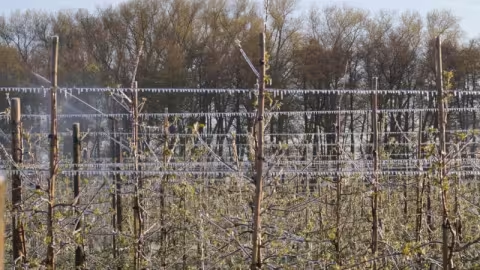
The effectiveness of anti-frost water application is based on a simple physical principle: when water freezes, it releases latent heat. This heat maintains plant tissues at a temperature close to 0°C, preventing them from dropping to damaging levels.
As long as water continues to freeze on the plant surface, the temperature remains stable. However, if water application is stopped prematurely, the ice can actually draw heat away from the plant, increasing damage risk. This makes correct system management essential.

Photo Rivulis - The effectiveness of anti-frost water application is based on a simple physical principle: when water freezes, it releases latent heat.
When and how to intervene
Timing is critical. Water application should begin before temperatures reach critical thresholds (typically around 2 to -1°C, depending on the crop and stage) and continue until ice begins to melt naturally after sunrise.
Key factors for effective use include:
- Uniform water distribution to ensures consistent protection across the field.
- Adequate application rate: must match the severity of the frost event.
- System reliability: continuous operation is essential during the event.
Modern irrigation systems, combined with sensors and automation, allow growers to monitor conditions in real time and respond quickly.
Results from the field: what to really evaluate ?
Damage reduction and production stability
Field experience consistently shows that properly managed anti-frost water application systems can significantly reduce damage. In many cases, growers report:
- Preservation of blossoms and fruit set.
- More uniform crop development.
- Reduced variability in yield.
This translates into greater production stability, even in years with challenging weather conditions.
Key performance indicators
To evaluate the effectiveness of frost protection systems, growers should consider:
- Yield levels compared to unprotected areas.
- Quality parameters (size, uniformity, marketability).
- Operation costs (water, energy, labor).
- System reliability during critical events.
Rather than focusing solely on immediate damage prevention, it is important to assess long-term economic benefits and return on investment.
Towards integrated climate risk management
Multifunctional systems
One of the key advantages of irrigation-based frost protection is its versatility. The same system used for frost control can also support:
- Regular irrigation during the growing season.
- Cooling during heat stress events.
- Fertigation for nutrient management.
This multifunctionality makes it a valuable investment in the context of increasingly variable climate conditions.
The role of planning and expertise
Effective frost protection is not just about equipment: it requires careful planning and technical expertise. Factors such as field topography, crop type, water availability, and climate patterns must all be considered.
Working with experienced agronomists and irrigation specialists can help growers design systems that are both efficient and adapted to local conditions. Monitoring tools, weather forecasts, and decision-support systems further enhance the ability to respond effectively.
Rivulis solutions
Rivulis offers a range of advanced irrigation and water application solutions designed to support frost protection across different crops and environments. From micro-sprinklers for under-canopy applications to sprinkler systems for full coverage, Rivulis technologies are engineered for reliability, uniformity, and ease of use.
By integrating frost protection into a broader irrigation strategy, growers can maximize the value of their investment while improving resilience to climate variability. With the right system design and management approach, it is possible to protect crops effectively and maintain consistent production year after year.
Conclusion
As climate patterns continue to shift, frost protection is becoming an essential part of sustainable agriculture. Growers must move beyond reactive approaches and adopt proactive strategies that combine technology, knowledge, and planning.
Among the available solutions, anti-frost water application with sprinklers system stands out for its proven effectiveness and versatility. When properly implemented, it not only protects crops from immediate damage but also contributes to long-term productivity and resilience.
In a world where uncertainty is the new norm, investing in reliable frost protection is not just about safeguarding crops: it is about securing the future of agricultural production.
Read more about Rivulis :Rivulis - Making Micro Irrigation Accessible Globally