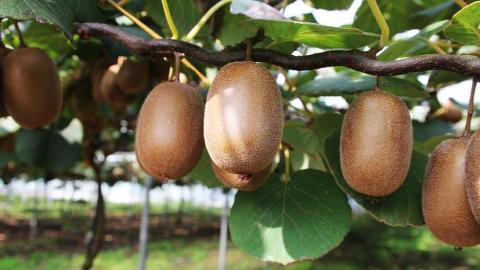
Across southern France, arboriculture is facing a new reality. Climate variability, increasing summer heat, and unpredictable weather events are transforming the way fruit growers manage their orchards. Maintaining fruit quality, tree health, and stable yields now requires innovative irrigation and climate-management strategies.
How precision irrigation helps orchards adapt to rising temperatures
Across southern France, arboriculture is facing a new reality. Climate variability, increasing summer heat, and unpredictable weather events are transforming the way fruit growers manage their orchards. Maintaining fruit quality, tree health, and stable yields now requires innovative irrigation and climate-management strategies.
Among the most promising developments is the use of precision irrigation technologies designed not only to supply water but also to regulate orchard microclimates. Cooling systems, canopy sprinklers and fogging, and intelligent fertigation solutions are helping farmers protect crops from heat stress while improving overall water efficiency.
A concrete example of this approach can be seen in Les Vergers du Ticol, a kiwi-producing farm in southwestern France, where irrigation technologies have become central tools for managing climate risk and supporting sustainable fruit production.
Modern Arboriculture in a Changing Climate
Les Vergers du Ticol represents a new generation of orchards that combine traditional horticultural knowledge with advanced irrigation and climate control systems.
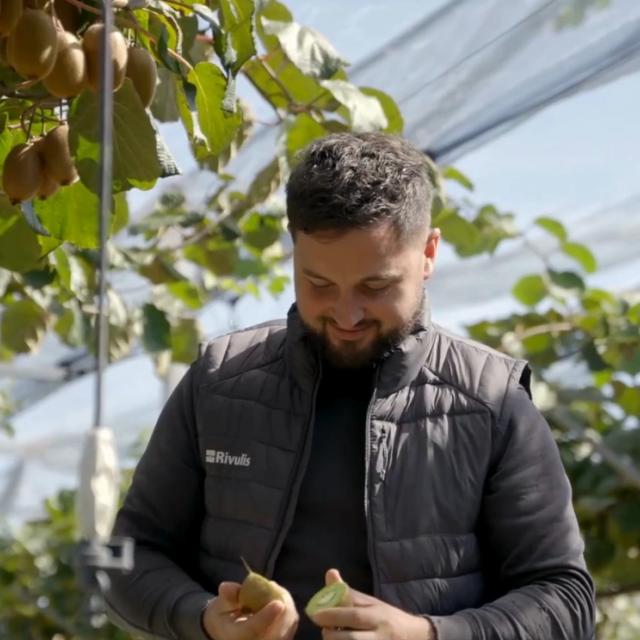
Under the leadership of Laurent Capayrou, the farm has expanded significantly over the past few years, growing from 28 hectares to 110 hectares. This development reflects both the increasing demand for high-quality fruit and the need to invest in technologies that can safeguard crops from climate extremes.
Kiwis play an important role in the farm’s production strategy. Currently grown on six hectares, the orchard is expanding with an additional three hectares of replanted trees, demonstrating the grower’s long-term commitment to this crop.
For arborists like Laurent Capayrou, orchard management is a continuous process of observation and adaptation. As he explains, arboriculture involves building the system from the ground up: planting trees, training their growth, monitoring fruit development, and adjusting management practices year after year.
However, modern orchard management must now take into account a growing number of environmental risks.
Increasing Climate Pressures on Orchards
Southern France has always offered favorable conditions for fruit production, but climate change is introducing new challenges that growers must address.
Among the most significant threats are:
- Spring frost events, which can destroy young buds and reduce yields.
- Hailstorms, capable of damaging fruit and tree structures.
- Extended heat waves, which create severe water and temperature stress.
- Irregular rainfall patterns, making irrigation management more complex.
In particular, extreme summer heat has become a major concern, especially in kiwi farming. High temperatures can disrupt photosynthesis, reduce fruit growth, and increase water loss through evapotranspiration.
High radiation + heat causes:
Sunburn patches on fruit Skin browning / necrosis
Internal quality loss:
-
- Lower sugar accumulation (Brix)
- Poor texture
Even short heat waves can make fruit unmarketable.
Kiwi has: shallow roots and high water demand under extreme heat transpiration demand spikes
Roots cannot keep up → plant water deficit and the risk:
-
- Wilting and Xylem cavitation (irreversible damage)
- Bud differentiation
- Early fruit development
Poor fruit set
-
- Reduced fruit size
- Lower yield next season
When orchard temperatures rise too high, trees may enter a stress response that slows growth and negatively affects fruit quality, at the season kiwi are supposed to grow during summer.
To mitigate these risks, farmers are increasingly turning to water cooling technologies that regulate orchard temperature while delivering water precisely where it is needed.
Canopy cooling: A Dual-Purpose Solution
At Les Vergers du Ticol, the orchard protection strategy relies on Rivulis' Rondo overhead irrigation and cooling system, installed beneath protective netting.
This system was selected because it allows the farm to address multiple climate challenges simultaneously. According to Laurent Capayrou, the installation provides protection against frost and hail while remaining compatible with protective net structures installed above the trees.
Unlike traditional irrigation systems that focus solely on soil moisture, overhead irrigation delivers water above the trees, creating a protective microclimate around the orchard canopy.
The system provides several advantages:
- Uniform water distribution along the rows
- Rapid coverage of leaves and branches
- Compatibility with netting systems
- Protection against frost damage
The principle behind frost protection irrigation is based on the latent heat released during water freezing. When water sprayed on plant tissues freezes, it releases heat that prevents temperatures from dropping below critical levels, thereby protecting sensitive buds.
But the benefits of overhead irrigation extend well beyond frost protection.
Cooling Orchards During Summer Heat
One of the most innovative aspects of overhead irrigation systems like Rondo is their ability to function as cooling technology during hot weather.
During periods of extreme heat, fine droplets of water sprayed across the canopy evaporate and lower the temperature around the trees. This process, known as evaporative cooling, helps create a more favorable environment for plant growth.
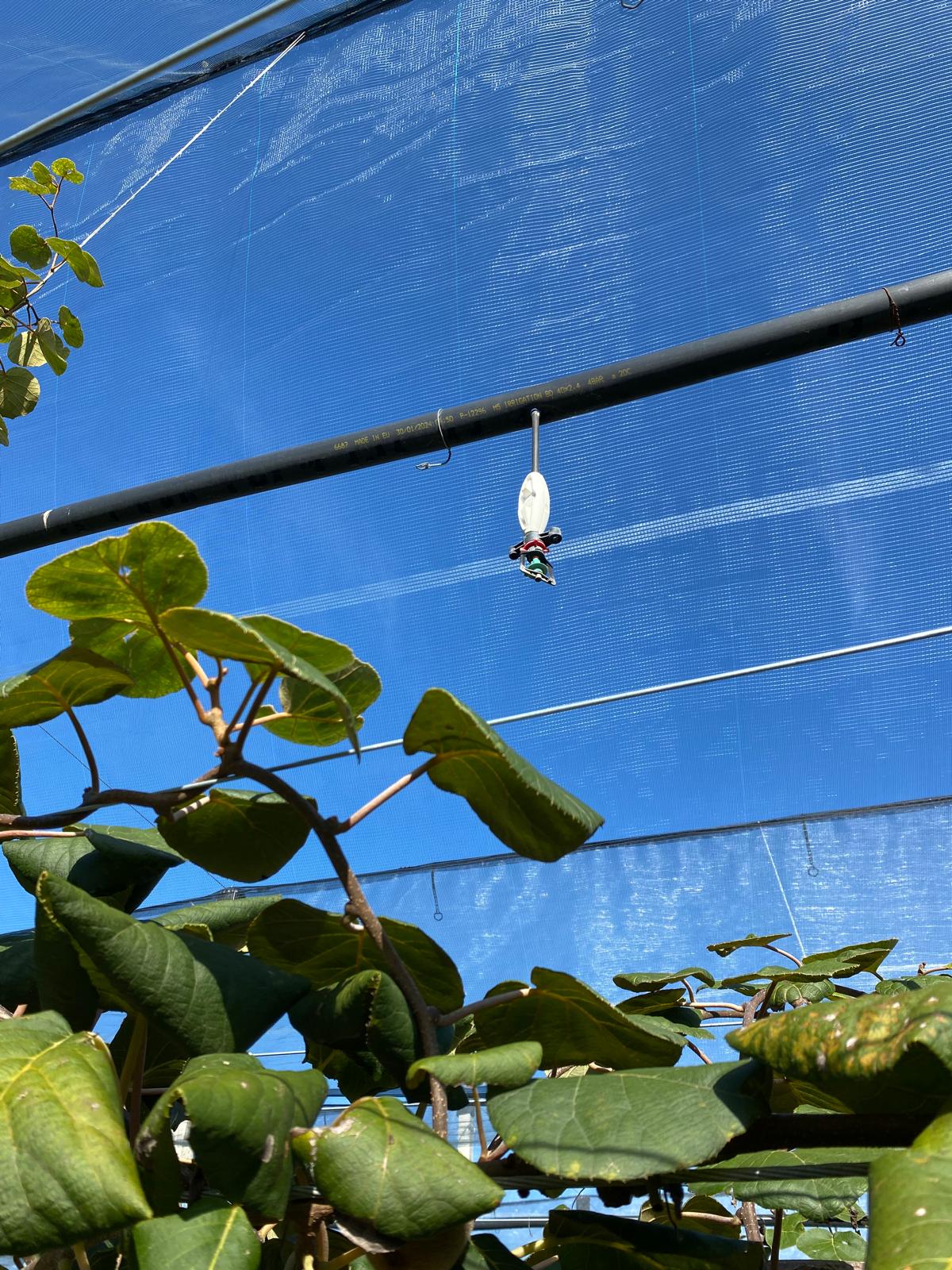
Photo credit: Rivulis
In kiwi orchards, this cooling effect can have several positive outcomes:
- Reduced leaf temperature
- Lower transpiration stress
- Improved photosynthesis efficiency
- Protect the fruit, increase the quality, the shape and the size of the kiwi fruits
By lowering canopy temperatures, growers can prevent heat stress that would otherwise affect fruit size, quality, and yield. And even make an impact on next year potential yield
In regions such as southern France, where summer temperatures can exceed 35°C, these cooling systems play an increasingly important role in maintaining orchard productivity.
As Laurent highlighted, this versatility makes canopy calling systems a year-round climate management tool, supporting both winter frost protection and summer heat mitigation.
Precision Irrigation Under the Canopy
While canopy irrigation protects the orchard from climatic extremes, daily irrigation needs must still be managed carefully to ensure optimal water use.
At Les Vergers du Ticol, this is achieved using the AquaSmart 2002 micro sprinkler system, a pressure compensated irrigation solution installed beneath the canopy.
Micro-sprinklers provide precise water distribution around each tree, delivering irrigation directly to the root zone. This allows farmers to maintain soil moisture levels that support healthy root development without wasting water.
The key advantage of such systems lies in their pressure-compensating design, which ensures consistent flow rates across the entire orchard, even when elevation or pressure variations occur.
To further optimize irrigation management, the farm uses hygrometric sensors placed throughout the plots.
These sensors monitor soil moisture and environmental conditions in real time, allowing irrigation to be adjusted based on the actual needs of the trees rather than fixed schedules.
As Laurent notes, irrigation can be controlled “down to the millimeter,” ensuring extremely precise water management and efficient fertigation practices.
Securing Irrigation Systems with Effective Filtration
Water quality is another critical factor in the performance of modern irrigation systems.
At Les Vergers du Ticol, irrigation water is sourced from the Tarn River, a natural supply that contains particles and algae which could potentially clog irrigation equipment.
To prevent these issues, the farm installed Rivulis F2400 sand filtration units, which play a crucial role in maintaining system reliability.
Effective filtration ensures:
- Protection of micro-sprinklers and sprinklers
- Reduced risk of clogging
- Consistent water flow during critical irrigation phases
- Longer equipment lifespan
This is particularly important during frost protection events, when irrigation systems must operate continuously and reliably.
Without proper filtration, debris could disrupt the system and compromise orchard protection at the most critical moments.
Technical Expertise and System Design
The success of advanced irrigation installations depends not only on equipment but also on careful system design and technical support.
In this project, the farmer worked closely with a Rivulis distributor and technical specialists to ensure the irrigation infrastructure was properly configured for the orchard’s specific conditions.
Several parameters were carefully evaluated during the design phase:
- Sprinkler spacing within rows
- Water flow rate per hectare
- Selection of appropriate sprinkler models
These technical considerations are essential to ensure uniform coverage and effective frost protection across the entire orchard.
Field-based expertise and collaboration between growers, distributors, and irrigation specialists help ensure that systems are tailored to local climate conditions and crop requirements.
Toward Resilient and Sustainable Orchards
For growers like Laurent Capayrou, the objectives of investing in cooling irrigation technologies are clear.
Modern orchards must deliver:
- High fruit quality
- Consistent yields
- Healthy and uniform tree growth
- Efficient use of water and nutrients
In a context where climate variability is increasing, irrigation and water application is no longer simply a tool for watering crops, it has become a strategic instrument for climate resilience.
Cooling technologies, precision irrigation systems, and smart monitoring tools allow farmers to maintain productivity while reducing environmental impact.
By combining canopy cooling, precision micro-irrigation, and advanced filtration systems, Les Vergers du Ticol demonstrates how innovation can strengthen the sustainability of fruit production.
The Future of Cooling system Technologies
As temperatures continue to rise across Mediterranean and southern European regions, cooling and irrigation technologies are likely to become an essential component of orchard management.
Future developments may include:
- Automated climate-response systems
- Integration with weather forecasting models
- AI-driven irrigation scheduling
- More efficient sprinkler designs
These innovations will help growers balance water conservation with crop protection, ensuring that orchards remain productive even under increasingly challenging climate conditions.
For farmers across southern France and beyond, the integration of cooling and irrigation technologies represents a crucial step toward climate-adaptive agriculture and long-term orchard sustainability.
read more about Rivulis :
Rivulis - Making Micro Irrigation Accessible Globally