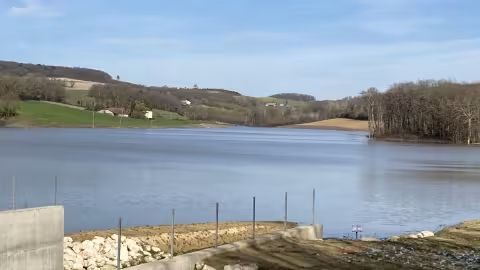
Enacted in August 2026, the Agricultural Emergency Act aims to strengthen France’s capacity to cope with droughts. Its section on water focuses in particular on expanding storage capacity, reusing wastewater, and streamlining procedures for certain water infrastructure projects. However, these provisions are causing serious concern among environmental groups.
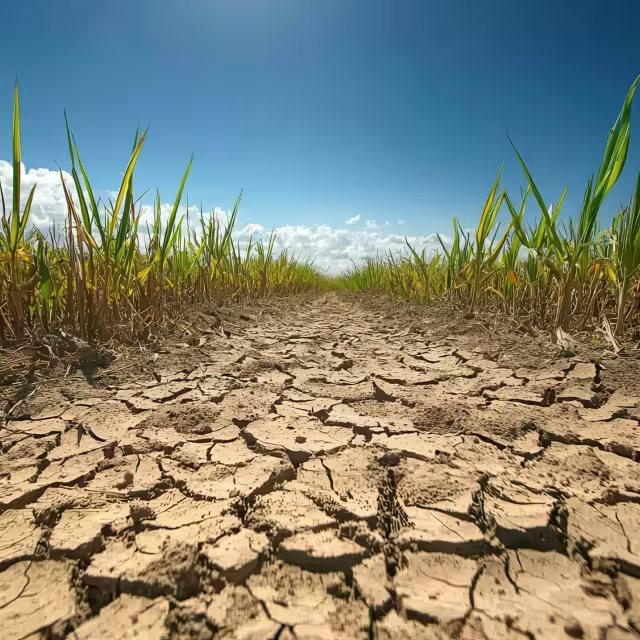
Faced with recurring droughts and growing tensions over water resources, the French government intends to provide more resources to secure the water supply for agriculture. The Agricultural Emergency Act, enacted in August 2026, thus provides for several measures designed to increase the volume of water available for irrigation.
The most significant measure sets a goal of doubling water storage capacity for agricultural use by 2035. In particular, the law encourages the creation or expansion of reservoirs and aims to make better use of the water available in existing bodies of water as well as in certain multi-purpose storage facilities.
More Storage, Simplified Procedures
The law also seeks to facilitate the implementation of new projects. The technical regulations applicable to certain reservoirs have been simplified, in particular for hillside reservoirs smaller than three hectares and bodies of water smaller than one hectare located in wetlands.
Projects involving wetlands that are already severely degraded also benefit from a tailored framework. The law provides that environmental compensation measures may be proportionate to the functions actually performed by the wetlands in question.
Another development: documents governing water management at the watershed and regional levels will need to give greater consideration to issues related to water storage and the optimization of water use. The Water Development and Management Master Plans (SDAGEs), as well as their local counterparts, the SAGEs, will need to take into account, in particular, the socioeconomic consequences of their policies on agriculture.
The legislation also strengthens the role of territorial water management projects (PTGE). These collaborative efforts among different water users are now enshrined in law, even though their implementation remains optional. Prefects will be able to establish a roadmap to identify storage facilities that could be integrated into these projects. Under certain conditions, they will also have the authority to grant exemptions to facilitate the development of storage projects. The consultation process has also been adjusted: for certain storage projects included in a PTGE, project sponsors may opt for an information session at city hall rather than public meetings as part of the environmental authorization process.
Wastewater Reuse Comes into Play
Storage is not the only measure provided for by the law. The government also aims to accelerate the reuse of treated wastewater (REUT), particularly for agricultural irrigation.
The stated goal is particularly ambitious: to increase the volume of treated wastewater reused by a factor of 30 by 2040, and then by a factor of 50 by 2050, compared to 2020 levels.
France had already begun to relax its regulatory framework. A decree published in August 2023 had notably simplified certain administrative procedures, while an order published in December of the same year had clarified the health requirements applicable to the reuse of treated wastewater for irrigation.
The new law is therefore part of this effort to develop an alternative resource to water drawn directly from natural environments.
A Controversial Bill on Water Management
These measures, however, sparked fierce tensions during parliamentary debates. According to supporters of the legislation, increasing storage capacity and utilizing alternative resources should enable agriculture to better withstand droughts and the consequences of climate change.
Conversely, environmental protection organizations and several political groups fear that the development of reservoirs will lead to excessive use of water resources for certain agricultural purposes, to the detriment of ecosystems and other water users.
The issue is particularly sensitive in regions already facing water shortages. Opponents of the bill are particularly concerned that relaxing certain environmental procedures will reduce the ability to assess the impact of new structures on wetlands and waterways.
The section on water has, in fact, been referred to the Constitutional Council, illustrating the controversy surrounding this reform.
Beyond the goal of water storage, the legislation thus raises a broader question: how should an increasingly scarce water resource be allocated among agriculture, drinking water supply, industry, biodiversity, and other uses? The practical implementation of the new provisions—particularly through executive orders and regional projects—will be crucial in gauging the reform’s actual impact.